
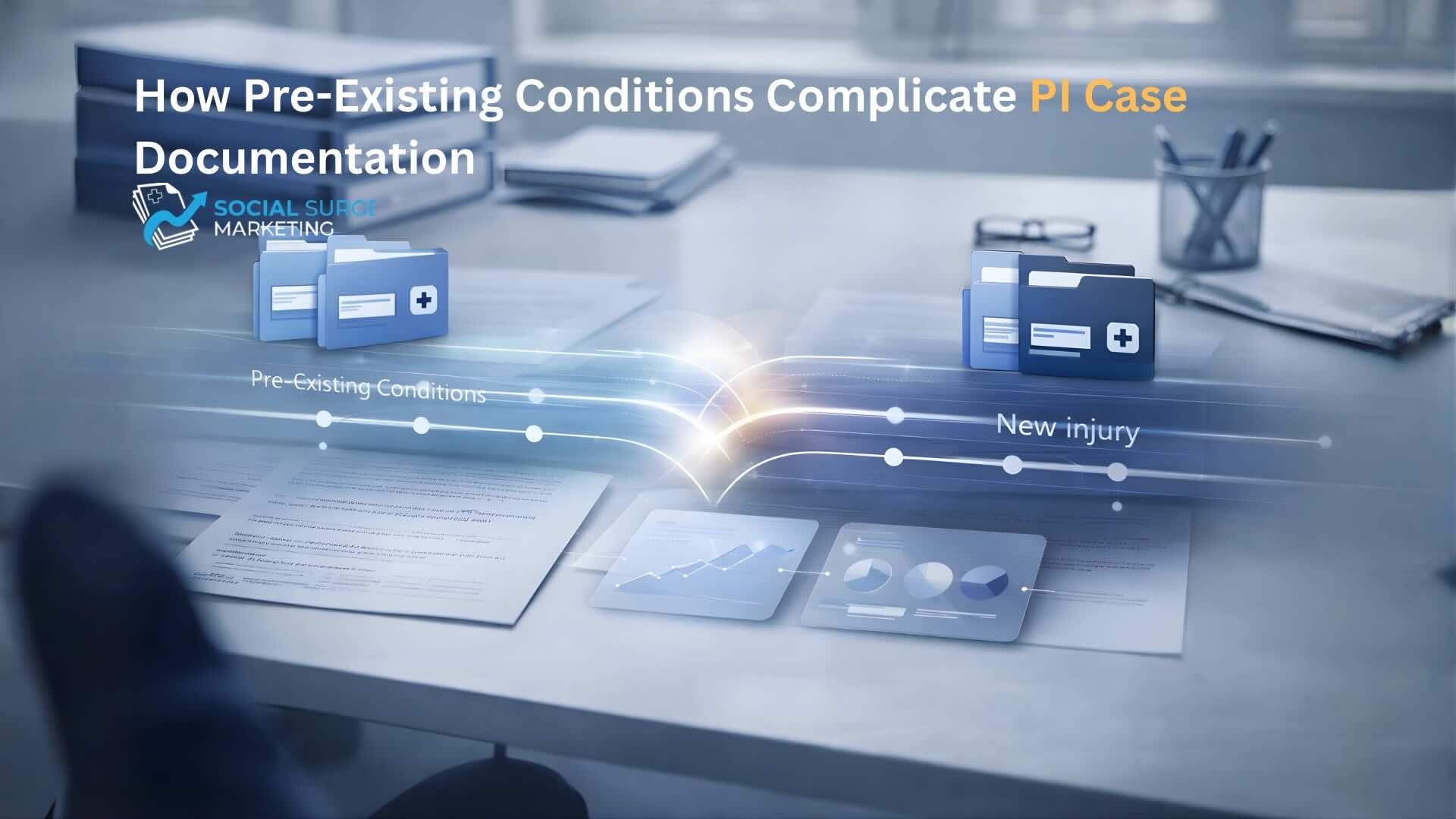
At first glance, many personal injury claims appear straightforward. However, once prior medical history enters the picture, even strong cases can become significantly harder to prove. Pre-existing conditions in personal injury cases are one of the most common reasons insurers dispute otherwise valid claims.
What initially seems like a clear injury can quickly turn into a complex discussion around causation, progression, and medical interpretation. The difference between a denied claim and a successful outcome often comes down to one critical factor: how clearly documentation separates what existed before the incident from what changed afterward.
Unlike more straightforward claims, cases involving prior conditions require a more structured and detailed approach. Conditions such as spinal degeneration, past trauma, or chronic pain often evolve over time, making it difficult to distinguish baseline health from post-incident changes. As a result, the strength of a claim depends heavily on how effectively medical records distinguish between prior conditions and new or aggravated injuries.
Insurance companies and defense attorneys closely examine whether the documentation establishes a clear and medically supported connection between the accident and the current condition. When records are consistent and aligned across providers, they significantly strengthen both causation arguments and damage evaluation. When inconsistencies appear, even valid claims may be questioned.
For attorneys and claim professionals, understanding how prior medical conditions impact documentation is essential to building a case that is both credible and defensible.
Why Pre-Existing Conditions in Personal Injury Cases Create Documentation Challenges
Pre-existing injuries are a common factor in personal injury litigation. Many individuals already have underlying conditions, prior injuries, or chronic symptoms before an accident occurs. The key issue is not whether these conditions exist, but how they are documented and interpreted after the incident.
When documentation lacks clarity, insurers often argue that the reported injury is not new but simply a continuation of an earlier condition. This creates serious causation challenges, making it harder to demonstrate that the incident caused measurable harm. In many pre-existing conditions in personal injury cases, unclear documentation is the main reason claims are disputed.
For a claim to remain defensible, medical documentation must achieve several key objectives:
- clearly distinguish between prior conditions and new injuries.
- demonstrate how the incident aggravated or worsened an existing condition.
- establish a timeline showing measurable changes in symptoms.
If these elements are missing or poorly defined, the claim becomes far more vulnerable to dispute.

Can You Still Win a Personal Injury Case with a Pre-Existing Condition?
A common concern in cases involving prior health issues is whether a claim can still succeed. In many situations, the answer is yes but only when documentation clearly supports it.
The legal standard does not require that the injury be entirely new. In fact, many successful claims are based on aggravation, where an accident worsens or accelerates an existing condition.
However, proving aggravation requires more than general statements. It demands clear medical evidence showing measurable changes in symptoms, function, or clinical findings. Without this distinction, insurers may argue that the condition would have progressed naturally over time.
This is where proper documentation becomes critical. The ability to clearly separate baseline health from post-incident changes often determines whether a claim is accepted or challenged.
For example, a patient with occasional back discomfort prior to an accident may later develop persistent pain and reduced mobility. Without proper documentation of this progression, insurers may argue that no meaningful change occurred.
The Legal Importance of Causation in These Cases
Causation is central to all personal injury claims, but it becomes significantly more complex when prior conditions are involved. This is especially true in cases involving pre-existing conditions in personal injury cases, where establishing a clear link between the incident and the injury is critical.
To establish causation, a claim must show that the incident either caused a new injury or materially worsened an existing one. Even when a condition existed beforehand, compensation is typically allowed for any measurable aggravation linked to the event.
Without clear documentation, insurers often rely on familiar defense arguments:
- symptoms were already present before the incident.
- the condition would have progressed naturally.
- current complaints are unrelated to the accident.
These arguments create serious challenges, especially when medical records lack consistency, detail, or continuity.
What Medical Records Must Clearly Show
To overcome challenges associated with pre-existing conditions in PI cases, medical records must present a structured and medically supported record that clearly separates past health history from current injury impact.
Baseline Medical History
Medical records should clearly establish the patient’s condition prior to the incident. This includes diagnoses, treatment history, imaging, and reported symptom levels.
Without a well-documented baseline, it becomes extremely difficult to demonstrate that the condition has worsened.
Symptom Changes After the Incident
One of the most critical elements is demonstrating how symptoms changed after the event.
For example, a patient who previously reported occasional discomfort but later experiences persistent pain, reduced mobility, or neurological symptoms shows a measurable change that should be consistently documented across all visits.
Objective and Clinical Findings
Objective findings such as imaging results, neurological evaluations, and functional assessments are especially important.
Even when prior conditions exist, new findings or measurable deterioration can support the conclusion that the injury has progressed due to trauma.
When these elements are documented clearly and consistently, they create a meaningful distinction between past conditions and current impact.

Common Documentation Mistakes That Weaken Claims
Even strong cases can lose credibility when small but critical errors appear in the record.
One common issue is failing to clearly separate prior symptoms from current complaints. Vague or inconsistent language can make a condition appear unchanged.
Incomplete medical history also creates problems. When prior conditions are not properly documented early, they may later appear as inconsistencies.
Differences in documentation across providers can be particularly damaging. Variations in how pain severity, mobility limitations, or neurological symptoms are described can raise concerns about accuracy.
These issues frequently lead to causation issues with pre-existing conditions, particularly when documentation weaknesses are present, giving insurers a basis to challenge the claim.
How Insurance Companies Evaluate Prior Conditions
Insurance companies actively look for signs of prior injuries as part of their evaluation process.
They review historical medical records, compare symptom descriptions, and look for inconsistencies between providers. Even minor discrepancies can be used to question credibility.
In many cases, insurers rely on independent medical examinations to argue that the condition was not significantly affected by the incident.
In practice, a large share of disputed personal injury claims involve some form of prior medical history, particularly in cases involving spinal conditions and chronic pain. This makes documentation one of the most influential factors in determining claim value, particularly when supported by structured medical record review.
The Role of Medical Experts in Complex Cases
In cases involving prior conditions, medical experts often play a critical role in interpreting complex documentation.
They evaluate whether symptom changes are consistent with the mechanism of injury and provide medical explanations for how trauma may aggravate an existing condition.
This is especially important when the distinction between prior and current injury is not immediately clear.
Expert analysis helps clarify documentation, resolve inconsistencies, and strengthen the overall case.
Strategies for Documenting Pre-Existing Conditions Effectively
Handling pre-existing injuries in personal injury cases requires a structured, coordinated approach between medical providers and legal teams.
Establish a Clear Timeline
A well-documented timeline should clearly show the condition before the incident and how it changed afterward.
Use Consistent Terminology
Consistency across providers is essential. Aligned language reduces contradictions and improves clarity.
Document Functional Impact
Records should describe how the injury affects daily activities, work performance, and overall quality of life.
When applied consistently, these strategies significantly improve documentation strength and credibility.

Why Clear Documentation Improves Claim Outcomes
When documentation is handled correctly, it can significantly influence the outcome of a claim. In pre-existing conditions in personal injury cases, clear documentation often becomes the deciding factor between approval and dispute.
Clear records allow attorneys to:
- demonstrate aggravation of an existing condition.
- support ongoing treatment needs.
- justify compensation for increased limitations.
Without this level of clarity, insurers are far more likely to dispute or undervalue the claim.
The Long-Term Impact of Poor Documentation
Failing to properly address prior conditions can have long-term consequences.
Unclear or inconsistent documentation often leads to reduced compensation or partial denial of claims. In more complex situations, it can result in prolonged disputes or litigation.
On the other hand, when documentation is consistent, detailed, and medically supported, it strengthens credibility and improves the likelihood of a favorable outcome.
Conclusion
Pre-existing conditions in personal injury cases introduce a level of complexity that significantly impacts how a claim is evaluated, challenged, and ultimately resolved. While prior medical history does not prevent a valid claim, it does require a higher standard of documentation.
The difference between a disputed case and a successful outcome often comes down to how clearly medical records separate past conditions from new or aggravated injuries.
When documentation establishes a clear baseline, tracks symptom progression, and supports causation with objective findings, it becomes one of the most important factors in securing fair and justified compensation.