

Spine injury claims can look strong on paper. The client reports persistent neck or back pain, reduced mobility, radiating symptoms, missed work, and a clear decline after the crash.
Then the MRI report comes back with language that sounds almost harmless: mild bulge, degenerative change, no acute fracture, or no obvious compression.
That is when many spine injury claims become vulnerable.
The issue is not just medical. It is strategic. When imaging and symptoms in spine injury cases do not line up neatly, insurance carriers often question causation, minimize damages, and suggest the client is exaggerating.
For personal injury attorneys, imaging and symptoms should not be treated as separate pieces of evidence. They must be connected through chronology, clinical findings, treatment response, and a clear medical narrative.
Strong spinal injury medical documentation helps turn a scattered record into a claim the carrier, experts, and jury can understand.
Why Spine Injury Claims Become Vulnerable
The biggest mistake in disputed spine injury claims is letting the MRI report become the center of the case.
A radiology report captures one point in time. It does not explain what happened before the scan, how symptoms progressed, or why treatment escalated afterward.
When imaging appears mild, insurance carriers may argue that:
- The injury is not serious
- The symptoms are subjective
- The findings are degenerative
- The crash did not cause the complaints
- The client is exaggerating pain or limitation
This is how a case with real value can start to look weaker than it actually is.
The issue is not always the strength of the injury. Often, it is how clearly the medical logic is shown in the record.
This is where spinal injury evidence in PI claims often starts to get questioned.
Hidden Risks When Imaging Falls Short
When imaging does not fully explain the symptoms, the defense may isolate one phrase from the MRI report and ignore the broader medical history.
They may focus on terms like:
- Mild disc bulge
- Degenerative change
- No acute fracture
- No significant compression
- Normal alignment
But those phrases do not tell the whole story.
They do not explain months of consistent pain complaints, therapy notes, medication changes, injection response, specialist referrals, functional loss, or worsening radicular symptoms.
In many cases, the difference between a vulnerable claim and a defensible one comes down to whether the record connects symptoms, treatment, and causation.
That is why comprehensive medical record review for spine injury claims is critical early in the case.
Why Imaging and Symptoms Don’t Match in Spine Injury Cases
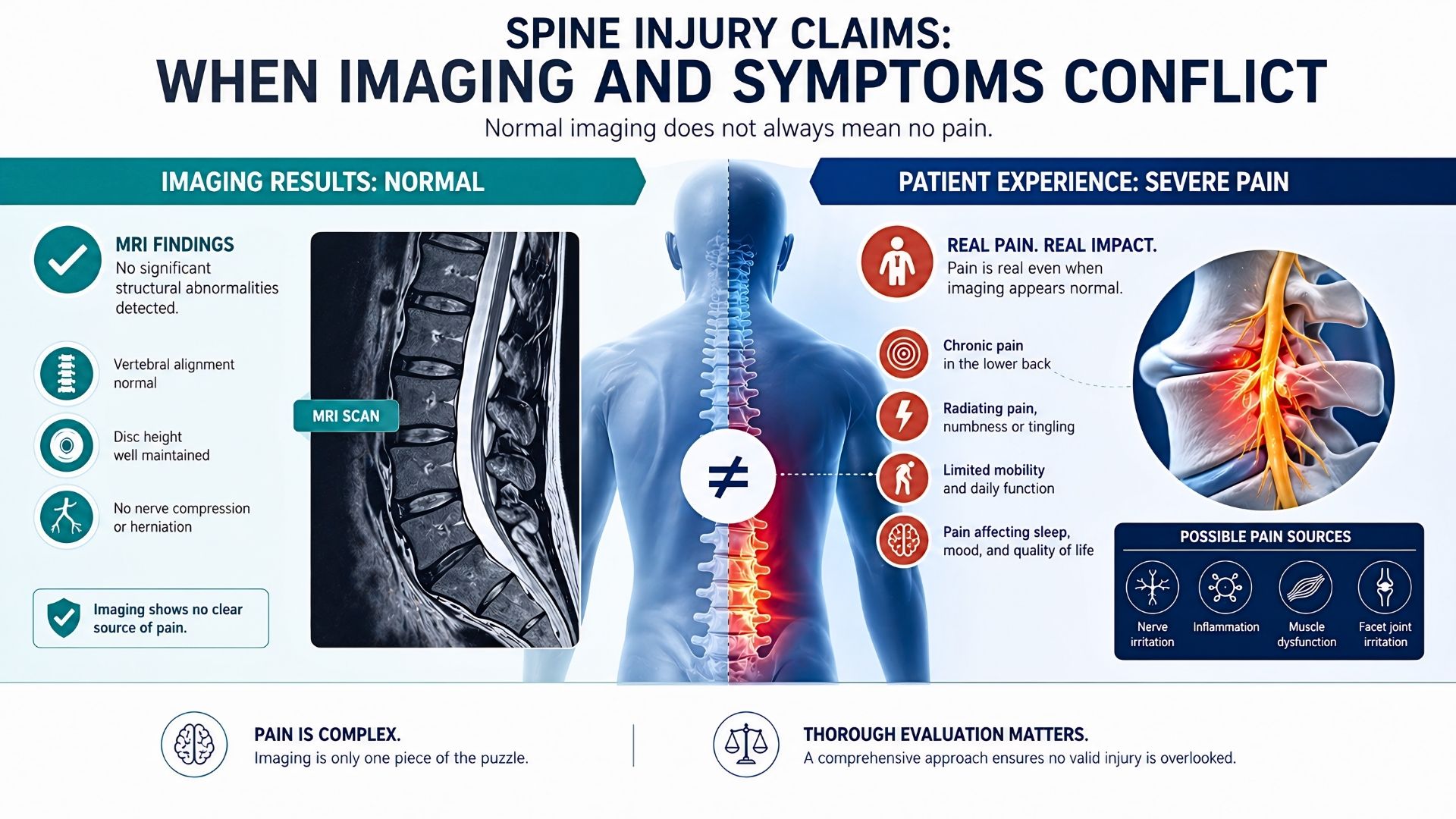
A mismatch between imaging and symptoms is common in spine injury cases. MRI and CT scans show structural findings, but pain, nerve irritation, and functional limitation often involve a broader clinical picture.
A patient may have visible disc findings with minimal symptoms, while another may have severe pain or reduced function despite mild imaging. That is why imaging and symptoms should be evaluated together, not separately.
When that connection is missing, insurers can use imaging language to challenge causation and minimize damages.
Structural vs Functional Injury
Imaging identifies anatomical findings such as fractures, disc abnormalities, herniation, stenosis, alignment changes, or compression.
But many spine injuries are functional. A scan may look mild, while the client develops radiating pain, numbness, limited range of motion, or worsening limitations over time.
In disputed spine injury claims, the full medical record must explain that difference clearly.
How Defense Experts Use Imaging Against You
In disputed spine injury claims, defense experts rarely need to attack the entire case. Often, they focus on one point and build the rest of their argument around it.
A single radiology phrase becomes the anchor for their opinion.
They may argue that:
- The findings are degenerative
- The complaints are subjective
- The mechanism of injury does not match the symptoms
- The MRI does not show acute trauma
- The client’s pain is unrelated to the crash
This is why the record cannot be left scattered.
A defense expert can make a strong case look weak when the attorney has to hunt through unorganized notes to prove consistency.
The issue is not just what the records contain. It is whether they can be understood quickly, logically, and persuasively.
The Real Battle in Spine Injury Claims Is Causation
When imaging is mild, unclear, or partly degenerative, the stronger question is:
What changed after the incident, and does the record support it?
Causation is not established by imaging alone. It is built through the full medical timeline.
A strong causation narrative should show:
- The client had no similar prior complaints, or prior issues were stable
- Symptoms began shortly after the crash
- Complaints were consistent across providers
- Clinical findings supported the reported pain pattern
- Treatment escalated based on medical need
- Functional limitations appeared or worsened after the incident
- Specialist evaluations supported the injury narrative
Degeneration should not be ignored. It should be contextualized through before and after evidence.
This is where coordinated medical expert support can make the treatment history medically and legally coherent.
From Weak Imaging to a Strong Spine Injury Case
Consider a common litigation scenario.
A client is rear-ended at a stoplight and reports neck pain with intermittent arm numbness within days. The MRI shows a mild cervical disc bulge with degenerative findings.
The carrier argues the imaging is not significant.
But the clinical history tells a different story.
The client had no prior neck complaints. Over time, the record shows limited range of motion, worsening symptoms, consistent radicular complaints, specialist referral, EMG findings, and temporary relief after injections.
The case becomes stronger not because the MRI changed, but because the medical story became coherent.
This is where spinal injury medical documentation starts to hold the case together. It connects symptom development, clinical findings, treatment response, and functional decline into a clear and defensible narrative.
What Strong Spinal Injury Medical Documentation Looks Like
Strong medical documentation in spine injury claims does more than collect records.
It shows how the medical story fits together.
A strong file should include:
- A clear treatment timeline.
- Consistent symptom reporting.
- Physical examination findings.
- Imaging results placed in context.
- Therapy notes.
- Medication history.
- Specialist referrals.
- Injection or procedure response.
- Functional limitations.
- Missed work or reduced work capacity.
- Prior medical history comparison.
Strong documentation is not about having more records. It is about having records that line up.
When this structure is missing, even valid claims can break down under scrutiny.
A client may report the same issue to multiple providers, but inconsistent wording, missing follow-ups, or unclear chronology can create doubt.
Without clear organization, the defense can frame the record as unreliable.
This is also where spinal injury evidence in PI claims becomes more vulnerable to challenge.
The Role of Expert Interpretation in Complex Spine Cases
In many spine injury claims, the issue is not a lack of evidence. The issue is whether the evidence is interpreted clearly enough to support causation.
Standard imaging does not always explain the full injury picture. Clinical findings, neurological symptoms, soft tissue involvement, inflammation, treatment response, and functional limitations may all matter.
Expert interpretation becomes especially important when:
- Imaging appears mild
- Degeneration is mentioned
- Symptoms are primarily functional
- Radicular complaints develop over time
- Treatment escalates after conservative care fails
- The carrier disputes causation
When imaging alone is not enough, the full medical record must explain why the client’s symptoms are medically consistent with the incident. This kind of structured analysis helps turn raw records into a clearer, more defensible spine injury case.
Turning Medical Evidence Into a Jury Ready Case Story
A jury does not need a radiology lecture.
It needs a clear explanation of why the client’s symptoms make sense.
Imaging is static. Injury is dynamic.
The MRI captures one moment. The injury is shown over time through pain patterns, physical findings, failed treatment, specialist concern, functional loss, and consistency across the record.
For complex spine injury claims, specialized spine injury case support services can help translate medical evidence into a jury-ready case story.
This is especially important when imaging and symptoms in spine injury cases must be interpreted together within the full medical record.
Conclusion
In spine injury claims, imaging matters, but it should not control the entire case.
When MRI findings and symptoms do not align, the medical record must explain what changed after the incident and why those changes remain medically consistent. Strong documentation connects symptoms, treatment progression, clinical findings, and causation into a clear, defensible narrative.
If a spine injury case involves mild imaging, disputed causation, degenerative language, or symptoms that do not match the scan, a professional medical record review can identify gaps before the defense uses them to weaken the claim.