
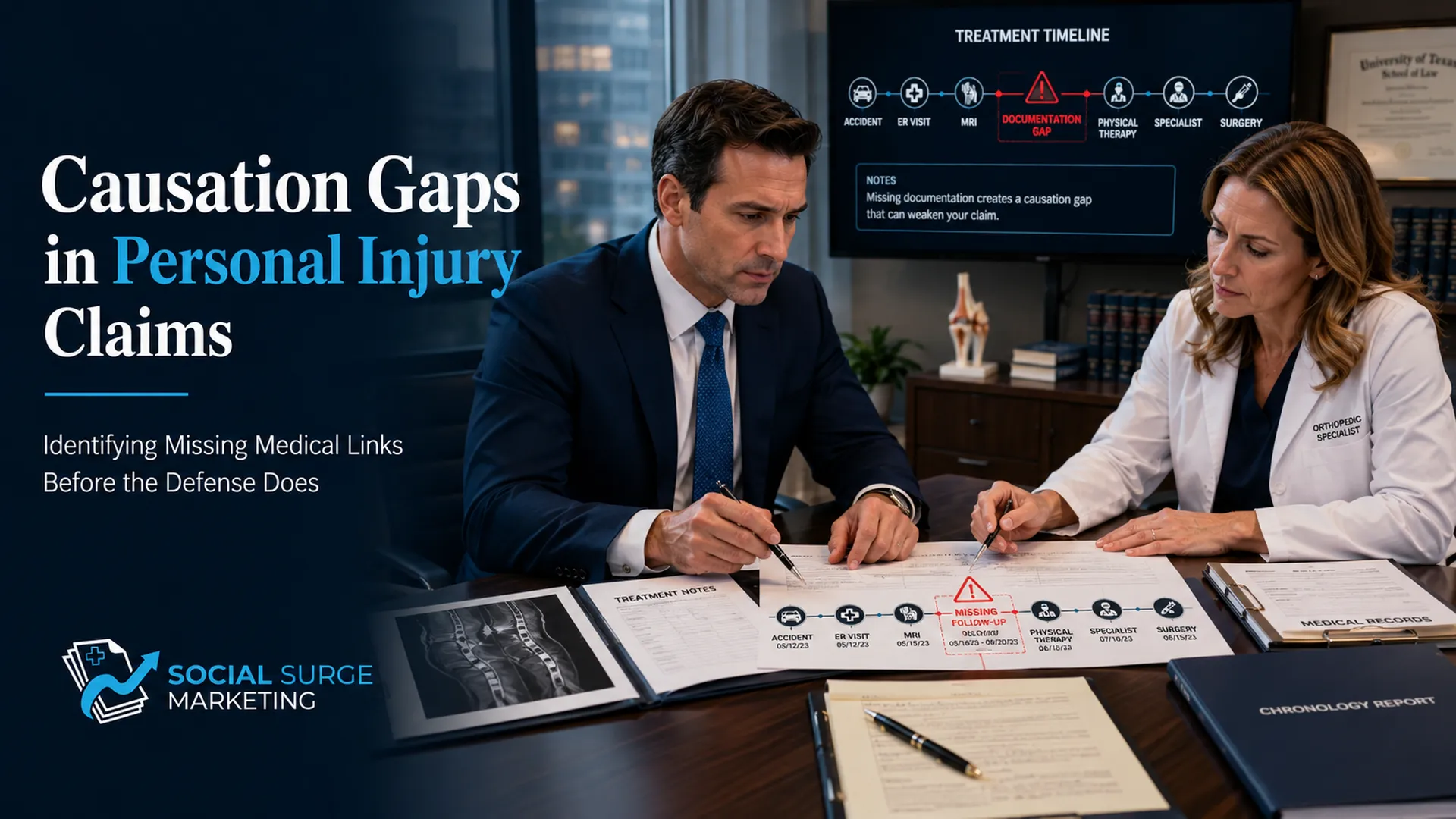
In a Texas personal injury case, liability can look clear while the file quietly weakens in a place the defense is already trained to examine. That weak point is often causation.
A police report may show that a crash happened, and medical bills may show that treatment followed. But those facts do not prove that this accident caused these injuries or that the care was medically connected to the event.
Causation gaps in personal injury claims are the missing links in the record. They appear when the file assumes a connection instead of documenting it. A diagnosis may be present. A treatment plan may be active. The client may have real pain and limitations. Still, if the medical record does not connect the condition to the accident, the defense has room to challenge the claim.
For Texas personal injury law firms, identifying causation gaps early can be the difference between a file that settles cleanly and one that becomes vulnerable during negotiation, mediation, deposition, or litigation.
This article is for informational purposes only and is not legal advice. Each claim should be evaluated based on its facts, records, medical evidence, and applicable law.
What Causation Gaps in Personal Injury Claims Actually Look Like
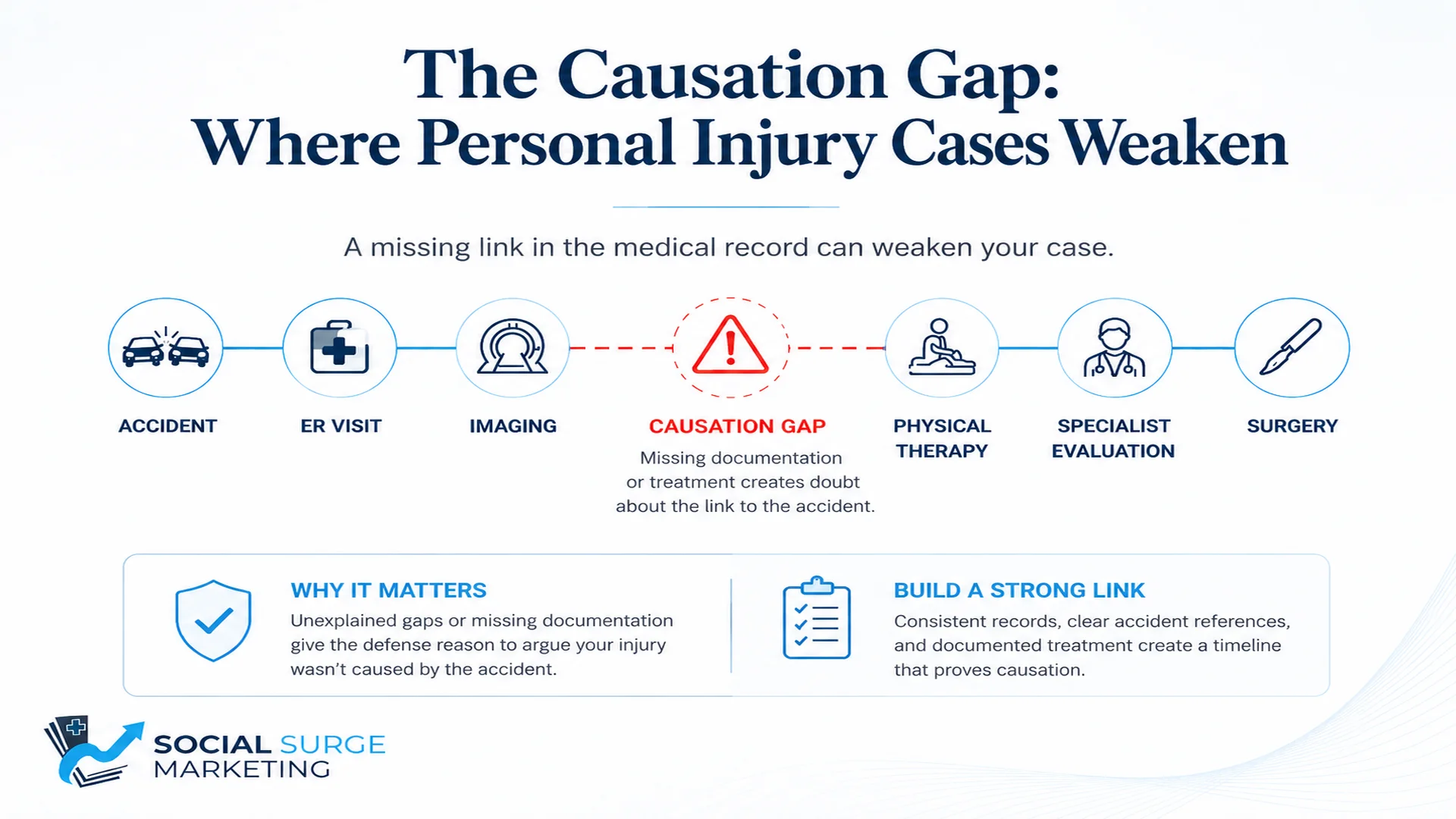
A causation gap is not simply a missing record. It is a missing connection.
The treatment exists. The bill exists. The injury may be real. The problem is that the file does not clearly explain why this particular condition traces back to this particular event.
These gaps tend to appear in predictable places. A first medical visit may record pain but never mention the accident. An MRI may show a disc herniation without explaining whether the finding appears acute, degenerative, or aggravated by the collision. A specialist referral may occur months after the crash with no clear thread connecting it to the original complaint.
Every personal injury claim depends on causation, medical necessity, and damages. Medical necessity and damages may look complete because treatment and bills are present. Causation fails more quietly because the missing link is often not obvious until the defense points it out.
Why Causation Matters in Texas Personal Injury Claims
In Texas personal injury claims, timing alone is often not enough to carry causation, especially when the injury is medically complex or overlaps with a prior condition.
Symptoms that appear after a collision may support the claim, but they do not always prove the collision caused them. The record should show the condition, the connection to the event, and the reason the treatment that followed was necessary.
For straightforward injuries, the connection may be easier to understand. A visible wound, a broken bone, or immediate pain after an accident may fall within the common understanding of a jury. More complex injuries require stronger medical documentation and, in many cases, competent expert medical evidence.
This becomes especially important in orthopedic injury claims, soft-tissue cases, disc injuries, internal injuries, and conditions that may overlap with aging, prior trauma, or degeneration.
When Expert Medical Evidence Becomes Necessary
The dividing line is whether a layperson could reasonably connect the injury to the accident without medical training.
Disc herniations, chronic pain conditions, soft-tissue injuries, nerve complaints, and degenerative findings usually require more than a simple timeline. The file needs medical support that explains how the mechanism of injury relates to the diagnosis.
When expert evidence is required and the record does not support the causal link, the claim can weaken even if liability is not seriously disputed. A clear clinical note tying the injury to the accident can give the eventual expert, attorney, adjuster, mediator, or jury a stronger foundation to follow.
How the Medical Timeline Builds Causation
Causation is built, not simply asserted. The strongest files show a logical sequence: the accident, a prompt first evaluation, a diagnosis tied to the mechanism of injury, and treatment that follows the diagnosis in a consistent line.
The first medical visit carries unusual weight. Accident-related injury documentation that names the collision, describes the mechanism of injury, and records initial symptoms helps anchor everything that follows.
If the first note omits the accident, the defense gains room to argue that the injury came from another source. If later records introduce new complaints without explaining why they appeared later, the defense may argue that those complaints are unrelated. If treatment escalates without a documented reason, the defense may challenge medical necessity as well as causation.
Consistency does much of the work. Each later visit that records the same complaints, tracks the same limitations, and connects care back to the original event strengthens the medical timeline.
How Treatment Gaps Weaken a PI Claim
A treatment gap is an unexplained break between the accident and care, or between one medical visit and the next. To a defense adjuster, a gap creates a question: if the injury was serious and related to the accident, why did treatment stop?
Clients pause care for legitimate reasons. They may lack transportation, miss work, wait for authorization, wait for imaging, or struggle with cost. They may also face delays when care depends on a letter of protection or another coordinated payment path.
When the chart explains the reason for the pause, the gap becomes easier to address. A short note stating that the client missed appointments because of work obligations, transportation issues, cost concerns, or referral delays can reduce the damage. Without that explanation, the defense can shape the silence.
If a PI team is reviewing treatment records only when demand is being prepared, causation gaps may already be difficult to fix. Social Surge Marketing helps Texas PI firms identify missing links earlier, while the record can still be strengthened.
Pre-Existing Conditions and the Causation Question
A prior injury to the same body part does not automatically defeat a personal injury claim. But it does change what the record must prove.
If the client had a previous back injury, prior shoulder pain, degenerative disc findings, or a history of treatment before the accident, the defense may argue that the current condition was not caused by the event. In those cases, the medical record needs to separate old from new.
That separation depends on a clear baseline. A strong record shows what the client’s condition looked like before the accident and how it changed afterward. Did pain increase after the collision? Did the accident aggravate a stable condition? Did the client need new treatment, imaging, injections, surgery, or specialist care?
Where degenerative findings appear on imaging, the key question may be whether the accident aggravated, accelerated, or made symptomatic a condition that had not previously required the same level of care. That answer belongs in the medical record, not only in legal argument.
How the Defense Attacks Causation
Defense strategy on causation is predictable enough to anticipate. The arguments vary by case, but the patterns are familiar.
The defense may argue that the injury existed before the accident, the imaging reflects chronic change rather than acute trauma, the first medical record does not mention the accident, the client delayed treatment, the treatment was excessive or unrelated, or an independent medical examination supports a different conclusion.
Each defense argument needs a documentary answer before the argument appears. A clean pre-injury baseline helps address the pre-existing condition argument. A first visit that names the accident helps close the chain-of-events gap. Notes explaining pauses in treatment help neutralize treatment-gap arguments. Imaging documentation that addresses acute findings, chronic findings, or aggravation helps reduce confusion around degeneration.
The same principle applies to referrals. If a specialist enters the file months after the accident, the record should explain why. Was conservative care attempted first? Did symptoms persist? Did imaging support escalation?
Common Defense Arguments on Causation
- The injury existed before the accident.
- The imaging reflects chronic or degenerative change rather than acute trauma.
- The first medical record does not mention the accident.
- The client delayed treatment after the event.
- The client had an unexplained break in care.
- The treatment was excessive, unnecessary, or unrelated.
- An independent medical examination supports a different conclusion.
- The medical records do not clearly connect the diagnosis to the mechanism of injury.
Why Early Medical Record Review Protects the Causation Record
Causation evidence has a practical shelf life.
The best time to identify a missing causation statement, an unexplained treatment gap, a weak referral trail, or a missing pre-injury baseline is while treatment is still active. At that stage, the firm may still request clarification from a treating provider, collect prior records, document the reason for a gap, or make sure future records address the issue more clearly.
Reviewed late, the same gaps become harder to solve. A missing causation statement cannot easily be added to a note written years earlier. A demand package may already be built on records that do not fully support the claim.
Structured medical record review turns a stack of treatment documentation into a file that can actually support causation. It helps the PI team see what the defense may see before the defense has the chance to use it.
What Early Record Review Can Help Identify
- Missing accident references in the first medical visit.
- Unexplained treatment gaps between appointments.
- Weak links between the diagnosis and mechanism of injury.
- Prior injuries or degenerative findings that need clarification.
- Specialist referrals that lack context or timing explanation.
- Imaging reports that do not address acute versus chronic findings.
- Missing notes about why treatment paused or escalated.
- Records that may need provider clarification before demand.
When these issues are found early, the firm has more room to act. The team may still be able to request clarification, collect missing context, or strengthen the medical timeline before the file reaches demand, mediation, or litigation.
Conclusion
Causation gaps in personal injury claims are rarely created in a single moment. They usually develop quietly through records that do not fully connect the accident, injury, diagnosis, and treatment. A treatment gap is never explained. A prior condition is not separated from a new injury. A complex diagnosis never receives a clear medical link. Imaging shows degeneration, but the record never explains whether the accident aggravated the condition.
By the time the defense raises these issues, the record may already be fixed. A file reviewed before demand may still be strengthened. A file reviewed after litigation begins may only be defended with what already exists.

Social Surge Marketing helps Texas personal injury law firms organize treatment records, surface documentation gaps, and coordinate expert-focused file preparation. Our support can help firms prepare stronger files for demand, mediation, settlement review, and litigation.