

Soft tissue injury claims are among the most common files a Texas personal injury attorney handles, and among the easiest for the defense to discount. The client may have real pain, real limitations, and legitimate treatment needs. The challenge is that the injury may not appear on an X-ray the way a fracture does.
That gap between what a client feels and what the record proves is where value is lost. When the medical file does not clearly establish causation, medical necessity, and damages, the defense gains room to argue that the injury was minor, exaggerated, or unrelated to the accident. The problem often appears during demand, mediation, negotiation, or litigation, when there may be little time left to strengthen the medical record.
This article looks at why documentation falls short in these cases and what a stronger soft tissue file should show before it reaches the other side.
Why Soft Tissue Injuries in Personal Injury Cases Are Often Undervalued
Insurers evaluate injury claims against objective medical evidence. A fracture on an image is hard to dispute. A muscle strain, a sprained ligament, or a cervical soft tissue injury frequently is not visible on standard imaging, so the file leans on the symptoms a client reports and the notes a provider records.
Adjusters know this. Soft tissue injuries in personal injury cases are often labeled minor impact soft tissue matters and moved toward a fast, low settlement. If the record does not counter that framing early, the claim may be undervalued before meaningful negotiation begins.
How the Defense Attacks Soft Tissue Cases
In many cases, the defense does not focus on whether an accident happened. Instead, it targets the connection between the accident and the injury, and the consistency of the treatment that followed. A soft tissue file with thin, scattered, or poorly connected records gives that strategy room to work.
Common Defense Arguments Against Soft Tissue Injuries
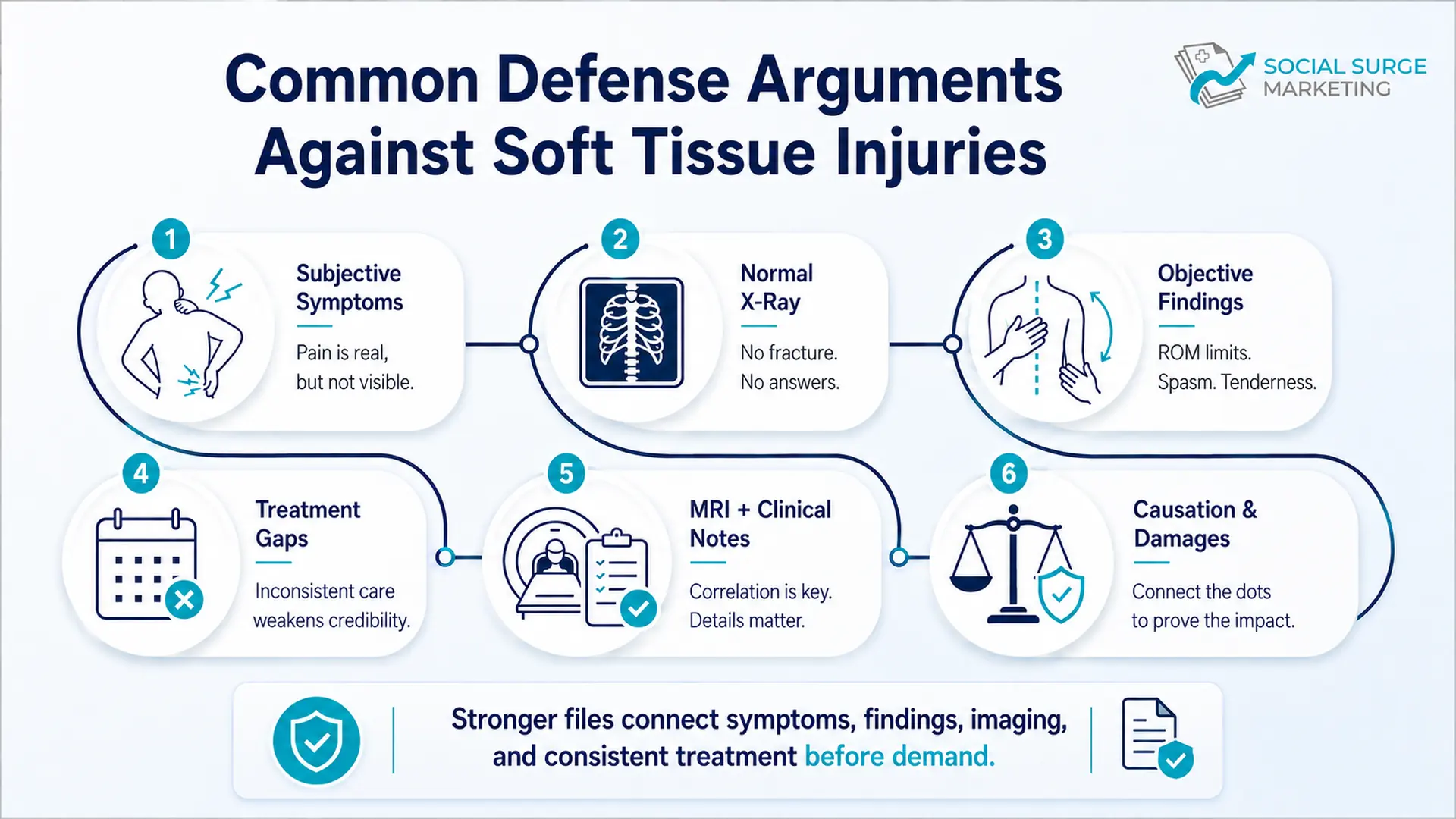
Several recurring arguments appear in these cases:
- The impact was too minor to cause a lasting injury
- The symptoms are subjective and cannot be measured
- Gaps in treatment show the injury resolved or was never serious
- The pain traces to a pre-existing or degenerative condition
- The imaging is normal, so no real injury exists
Each argument targets a documentation weakness rather than the injury itself. A structured medical record review is often what surfaces those weaknesses while the file can still be strengthened.
Documenting Injury Severity Beyond Patient Complaints
A stronger file does not rely on pain reports alone. It pairs the client account with functional findings a provider can observe and record, such as reduced range of motion, muscle spasm, or specific limits on daily activity.
When those objective findings appear consistently across visits, the record shows a measurable injury rather than a subjective complaint. That consistency is what makes medical necessity harder to challenge.
What Medical Records for Soft Tissue Injuries Show
Medical records for soft tissue injuries carry more weight when they tell a continuous story rather than a set of disconnected visits. The strongest files move from the first clinical encounter through diagnosis, treatment, and either resolution or a documented plateau.
Complete records generally include the initial evaluation, provider notes describing symptoms and findings, imaging reports, therapy documentation, and a prognosis. When any of these records is missing or incomplete, the defense may use that absence to argue that the injury was not significant.
When the record is organized in that sequence, each gap becomes visible early rather than surfacing for the first time at demand.
The Treatment Gap Problem in Documentation
Consistency of care is one of the most common documentation issues in soft tissue injury claims. Soft tissue injuries often improve slowly, and clients miss appointments, stop therapy early, or wait before seeking care. Each gap becomes an argument that the injury healed or was never serious.
The record cannot erase a gap, but it can explain one. Notes that document the reason for a delay, a pending referral, or a client following home care all give context that a bare timeline lacks. Ongoing treatment oversight across providers helps keep that context in the file as the case develops.
How Imaging Supports Soft Tissue Injury Claims
Standard X-rays usually do not show soft tissue damage, which is part of why these claims are challenged. An MRI can reveal tears, inflammation, or ligament changes that an X-ray misses, and it moves part of the injury from subjective to objective.
Imaging is not available or appropriate in every case. When it exists, the report should be read against the clinical notes so the file presents one consistent account rather than two documents that are never connected.
Pre-Existing Conditions and the Aggravation Argument
Many clients have a prior neck, back, or shoulder issue, and the defense will point to it. A prior condition does not defeat a claim, but the record has to draw a clear line between the earlier state and the change the accident caused.
That line depends on documentation. Records that establish the client baseline before the accident, then show a measurable change after it, support an aggravation argument. Linking a new injury to an old one without that contrast is where many causation gaps in the record begin.
How Documentation Gaps Affect Demand and Settlement
A demand is only as strong as the file behind it. When a soft tissue file reaches demand with missing records, unexplained gaps, or imaging that was never reconciled with the notes, the number is easy for an adjuster to discount.
Building the file in a clear sequence changes that dynamic. A clear medical chronology that ties each record to the injury and its progression gives the demand a foundation the defense has to answer rather than dismiss.

Reviewing Soft Tissue Injury Claims Before Demand
The most useful time to review a soft tissue file is before the demand goes out, not after the defense responds. An early review surfaces missing records, unexplained gaps, and weak causation while there is still time to request records, clarify notes, or coordinate added documentation.
This matters most in claims that do not resolve quickly. Soft tissue injuries that persist can develop into chronic pain cases, where consistent documentation over months becomes the difference between a supported claim and a discounted one.
Frequently Asked Questions About Soft Tissue Injury Claims
Texas PI attorneys often field these questions from clients during a soft tissue claim. These answers are informational only and not legal advice for any specific case.
Why are soft tissue injuries hard to prove?
Soft tissue injuries involve muscles, ligaments, and tendons, which usually do not appear on a standard X-ray. Without a visible fracture, the claim relies on reported symptoms, consistent treatment records, and provider findings. That reliance on subjective evidence is why insurers question these claims and why thorough documentation matters so much.
Do soft tissue injuries show up on an MRI?
Sometimes. An MRI can reveal tears, inflammation, or ligament damage that an X-ray does not capture, which is why it is often used when a soft tissue injury is suspected. A normal MRI does not automatically rule out injury, because some soft tissue conditions may still depend on clinical findings and symptom progression.
How does a treatment gap affect a soft tissue injury claim?
A gap in treatment gives the defense an opening to argue that the injury healed or was never serious. The gap itself does not end a claim, but the record should explain it. Notes describing a referral, a delay, or home care provide context that a bare timeline does not.
How long do you have to file a soft tissue injury claim in Texas?
Most Texas personal injury claims fall under a two-year deadline set by Texas Civil Practice and Remedies Code Section 16.003. Certain situations can change that period, so the applicable deadline should always be confirmed against the statute and the specific facts of the case.
What documentation helps support soft tissue injury claims?
Helpful documentation may include the initial evaluation, consistent provider notes, objective findings such as range-of-motion limits or muscle spasm, therapy records, imaging reports when appropriate, treatment recommendations, explanations for gaps in care, and notes connecting the injury to the accident. The stronger the sequence of records, the harder it is to dismiss the claim as minor or unrelated.
Final Thoughts
Soft tissue injury claims are not weak by nature. They are vulnerable when the documentation does not keep pace with the injury. The medical facts may support the claim fully, yet a file with gaps, thin records, or unreconciled imaging hands the defense a discount it did not earn.
The work that protects these claims happens early, in how the record is built and reviewed before demand. A file that establishes causation, medical necessity, and damages in a clear, consistent sequence is far harder to reduce to a minor injury.
Need help strengthening the medical side of a soft tissue file? Social Surge Marketing helps Texas PI law firms review medical records, identify documentation gaps, organize treatment timelines, and prepare clearer medical support before demand, mediation, settlement review, or litigation. Our team helps turn scattered treatment records into a more organized case narrative that attorneys can use with greater confidence.