
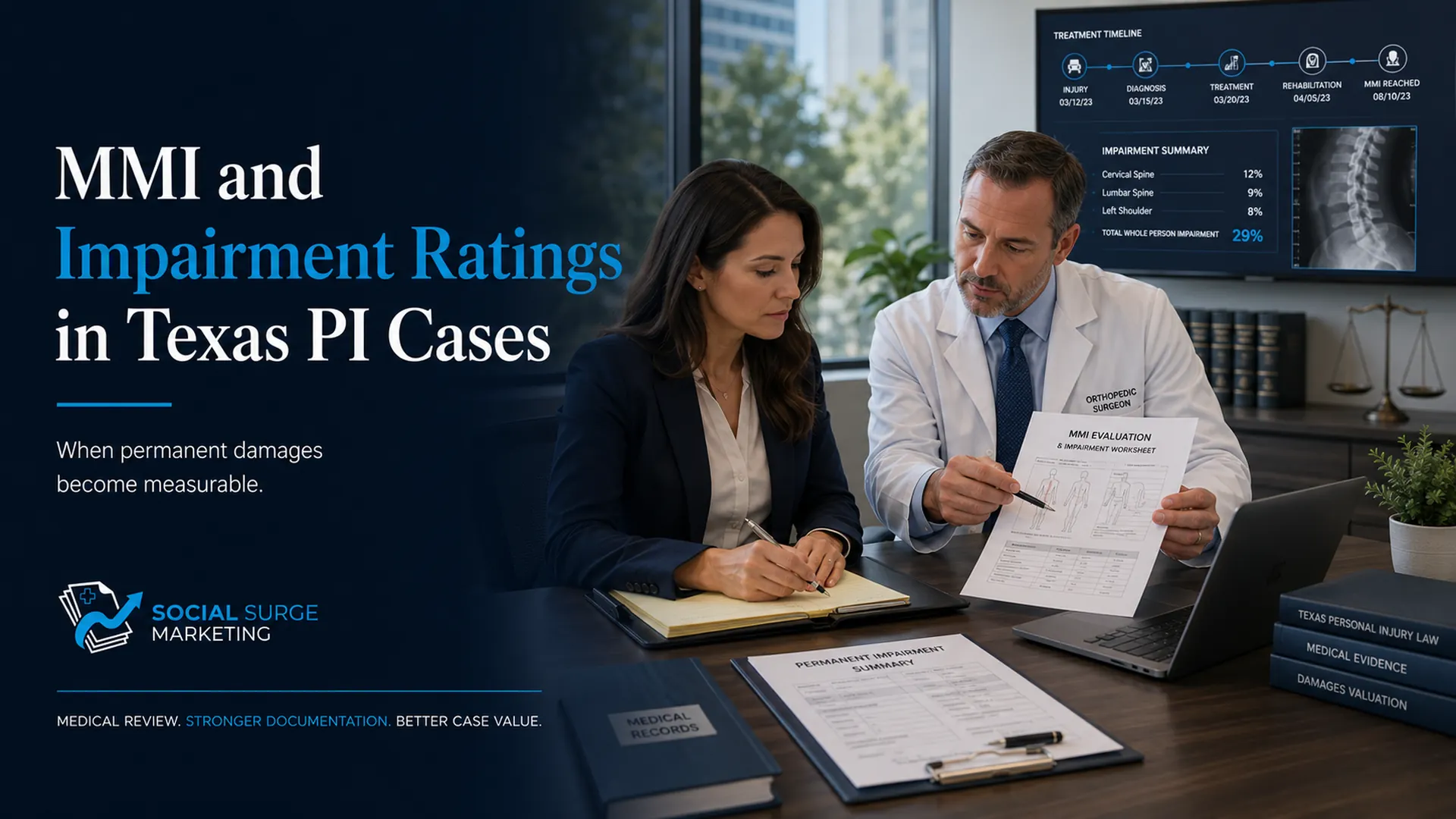
In many Texas PI files, the medical records are complete, the treatment is documented, and the case may still become difficult to value once the attorney begins assessing permanent damages. The missing piece is often a clear record of when the client reached maximum medical improvement and what permanent impairment, if any, remained.
MMI and impairment ratings in personal injury cases sit at the center of how permanent damages get proven. Together, they help define whether lasting effects remain and provide medical support for the permanent-damages analysis used during demand preparation, negotiation, mediation, and litigation.
For Texas PI attorneys, the challenge is rarely obtaining a rating. It is making sure the file documents the basis for that rating clearly enough that the defense cannot pick it apart. Well-documented MMI and impairment ratings can help connect permanent medical findings to the damages presented in a Texas personal injury claim.
What MMI Means in a Texas Injury Claim
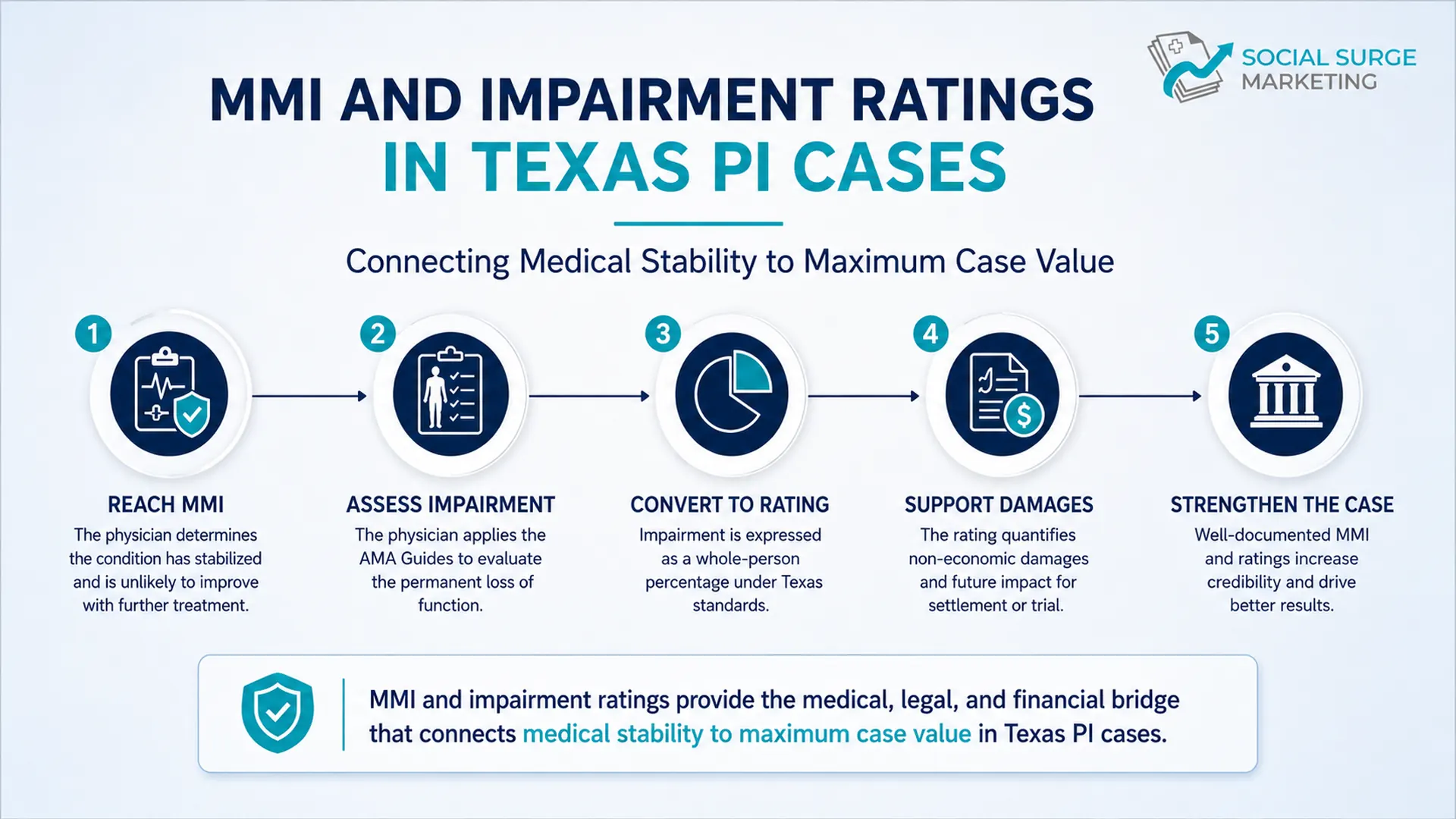
Maximum medical improvement is the point at which a treating physician determines that a condition has stabilized and is unlikely to improve significantly with further care. It does not mean the client has fully recovered or is free of pain. It means the medical picture has become predictable enough to evaluate.
For the file, this is the moment the permanent consequences of the injury can be assessed. Before that point, future medical needs and lasting limitations remain estimates. After it, they become documentable facts a physician can support. When several providers are involved, structured treatment oversight can help document when the client’s condition began to plateau and whether the providers reached consistent conclusions.
How Impairment Ratings Support Permanent-Damages Claims
An impairment rating converts a physical loss into a number. A physician assigns a percentage that reflects how much function the body has permanently lost. That figure gives attorneys, insurers, experts, and fact-finders a structured reference point for discussing permanent loss. It does not establish a dollar value by itself, but it can strengthen the medical foundation for future-care, functional-loss, and non-economic damage claims. Ratings are most useful in claims involving lasting physical loss, including orthopedic injury cases involving fractures, joint damage, reduced range of motion, or surgical intervention.
The rating is useful because it translates documented medical findings into a standardized measure of permanent functional loss. Within the same rating methodology, a higher whole-person percentage generally reflects a greater degree of permanent functional loss. The number is not the entire damages picture, though. A modest percentage can still coincide with significant limits on daily life and work.
Whole-Person Impairment and the AMA Guides
Many physicians use the American Medical Association’s Guides to the Evaluation of Permanent Impairment when evaluating permanent functional loss. Although Texas personal injury claims do not generally require a rating under a specific edition, a report that identifies the methodology and criteria used is easier to evaluate and defend. The Guides give physicians a structured method for rating each body system and converting a specific loss, such as reduced shoulder motion, into a whole-person figure. Because the method is standardized, a rating tied clearly to the Guides is harder to dispute than one stated without that support. The file should show which edition and criteria the physician applied.
Why PI Cases Differ From Workers’ Comp Ratings
Texas attorneys sometimes carry assumptions from the workers’ compensation system into PI files, and the two operate differently. In workers’ comp, an impairment rating is mandatory and drives income benefits. Under Texas Labor Code Section 408.124, the rating must follow the AMA Guides, and it cannot be assigned until MMI has been certified.
Personal injury claims have no equivalent statutory rating requirement. Here, impairment ratings in Texas injury claims function as medical evidence, not as a benefit formula. The rating supports causation, medical necessity, and damages rather than triggering a fixed payment schedule. That gives the attorney more flexibility and places more weight on how well the rating is documented.
What the MMI Report Should Document
A useful MMI report does more than state a date and a percentage. It gives the file a defensible foundation. At minimum, the documentation should make clear:
- The date MMI was reached and the clinical reasoning behind it
- The permanent impairment rating and the Guides edition used
- Permanent restrictions and their effect on daily activity and work
- The future medical care the physician expects the client to need
When these elements are present, the connection between injury and long-term damages reads as a medical conclusion rather than an argument. A clear medical chronology can show whether the MMI date, restrictions, future-care recommendations, and impairment findings remain consistent across the record.

How Defense Teams Challenge MMI and Ratings
Defense review of an MMI report is predictable. The goal is to weaken the link between the injury and the permanent rating. Common challenges include:
- A rating assigned without a clear reference to the AMA Guides
- An MMI date that appears premature or inconsistent with the treatment record
- Gaps in care that suggest the client had recovered earlier
- A rating that does not separate the current injury from prior conditions
Without a documented basis for each point, the defense may frame the rating as inflated or unsupported.
Pre-Existing Conditions and Apportionment
The strongest defense angle is often a prior condition. When a client has a documented history involving the same body part, the physician should address that history directly. Where medically supportable, the report may distinguish pre-existing impairment from the additional loss caused or aggravated by the current injury. If a precise allocation cannot be made, the physician should explain why and identify the findings that support the current injury’s contribution.
Documenting the Rating’s Medical Basis
The response to most rating challenges is documentation, not argument. When the physician’s report cites the specific tables and findings behind the percentage, the rating stops looking like an opinion and reads as a measured conclusion. Coordinating qualified medical experts to explain that basis, once a case reaches litigation, gives the rating support the defense cannot easily match.
Why Settlement Timing Turns on the MMI Date
Reaching MMI often marks the point at which a claim can be valued with greater confidence because the client’s permanent limitations and anticipated future care are clearer. Settling before MMI may require the parties to value the claim while future treatment needs and permanent limitations remain uncertain. Because settlement documents often include a release of future claims, attorneys must evaluate those uncertainties carefully.
Reaching MMI first protects the claim in several ways:
- Future medical costs can be projected rather than estimated
- A permanent impairment rating can provide additional medical support for the claim’s long-term damages
- Non-economic damages reflect the full, lasting impact of the injury
Timing does not mean delay for its own sake. It means holding the demand until the medical record can support the number the file is asking for.
Reviewing MMI and Rating Documentation Before Demand
The most productive time to examine an MMI report is before the demand goes out, not after the defense raises questions. A pre-demand review confirms that the MMI date, the rating, the Guides reference, and the future-care projection all appear in the record and agree with one another.
Where a gap exists, there is still time to request clarification from the treating physician. Once the demand is filed, the same gap becomes a point the defense controls. Reviewing the file at this stage keeps the medical foundation aligned with the damages the claim presents through negotiation and, if needed, trial.
A pre-demand review of MMI and impairment ratings can reveal documentation gaps before the defense has an opportunity to use them.
Frequently Asked Questions About MMI and Impairment Ratings
Texas PI attorneys often field these questions from clients as a case approaches settlement. The answers below are informational only and not legal advice for any specific case.
What is maximum medical improvement in a personal injury case?
Maximum medical improvement is the point at which a physician determines that a condition has stabilized and will not improve significantly with more treatment. It does not mean full recovery. It marks the moment the permanent effects of the injury can be evaluated, which is why it often becomes an important milestone in settlement evaluation.
What is the difference between an impairment rating and a disability rating?
An impairment rating measures permanent loss of bodily function from a medical perspective and is usually expressed as a percentage. Disability is a broader legal or vocational concept that considers how the condition affects activities, employment, or earning capacity. A relatively low impairment percentage can still produce substantial work or daily-life limitations.
Can a personal injury case settle before the client reaches MMI?
Yes. A personal injury case can settle before the client reaches MMI, but doing so may leave uncertainty about future treatment, permanent restrictions, and lasting functional loss. Waiting until MMI often provides a clearer medical basis for evaluating the claim, although the appropriate timing depends on the facts of the case.
Does every Texas personal injury claim need an impairment rating?
No. Unlike workers’ compensation claims, Texas personal injury cases do not have a general statutory impairment-rating requirement. A rating is most useful when an injury leaves a lasting and measurable loss of function. Claims involving temporary symptoms that resolve without permanent measurable loss may not require a formal impairment rating, while cases involving lasting restrictions often benefit from one.
Final Thoughts
MMI and impairment ratings often shape when a Texas PI claim can be valued with greater confidence and how effectively its permanent damages can be supported. The rating itself is rarely the central weakness. More often, the problem is a report that states a percentage without explaining the medical findings and methodology behind it. A file that documents the MMI date, the rating, the applicable criteria, permanent restrictions, and expected future care gives the defense less room to characterize the permanent-damages claim as unsupported.
Need help organizing MMI and impairment documentation? Social Surge Marketing provides medical-legal support for Texas PI law firms, including record review, treatment timeline analysis, documentation gap identification, and medical expert coordination. Our team helps attorneys prepare clearer medical files for demand, negotiation, mediation, and litigation.