
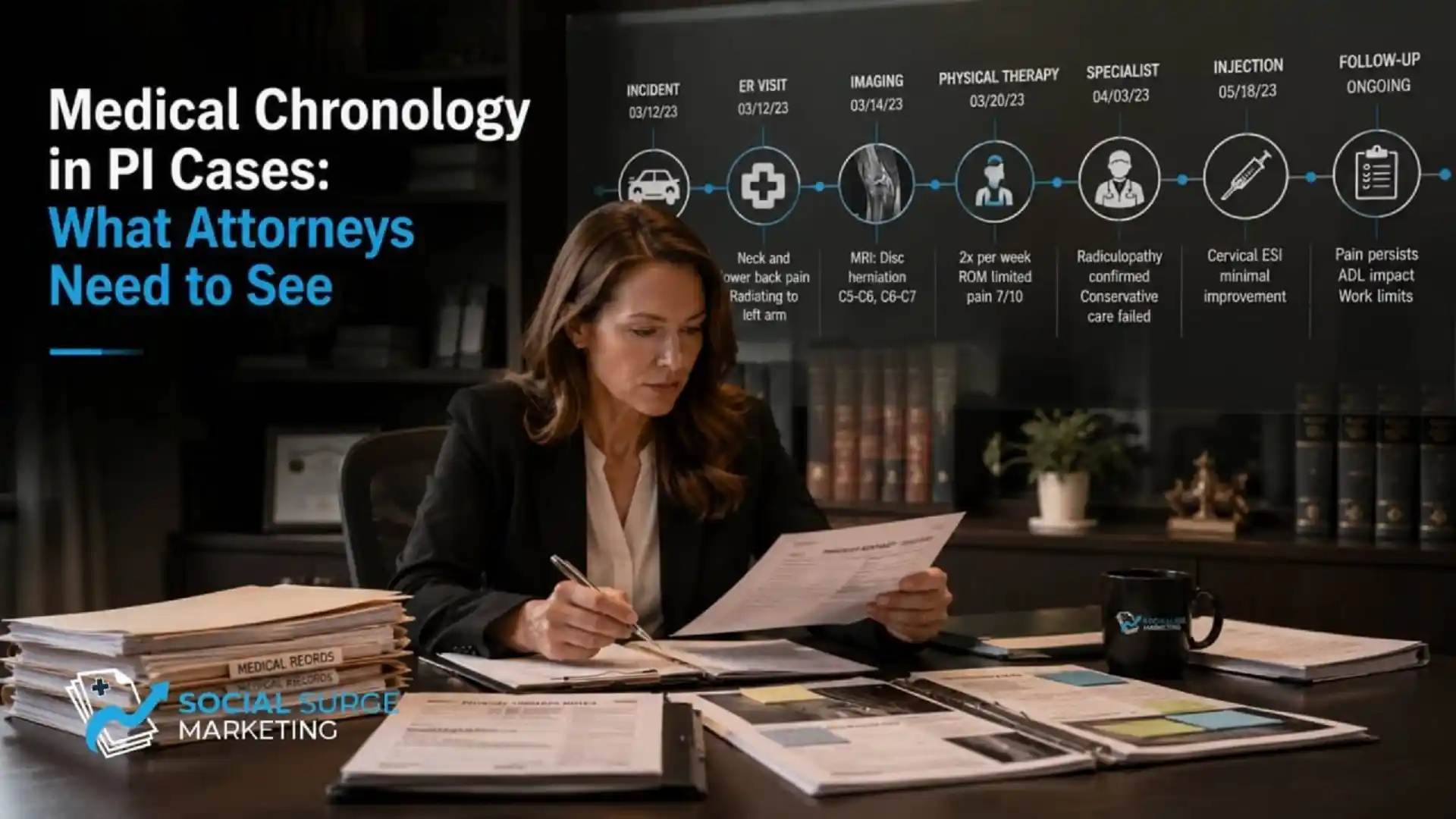
A case can include every medical record and still be hard to evaluate if no one can see the medical story. A medical chronology in personal injury cases should bring that story into focus before demand, mediation, or litigation pressure begins.
PI files often spread emergency notes, imaging, therapy, referrals, billing, restrictions, and follow-up care across different providers. Without a clear chronology, important facts can look disconnected, even when the records are present.
Attorneys need to see what changed after the incident, how treatment progressed, where causation and damages are clear, and where the file still needs context.
For Texas PI firms, a well-built chronology can turn scattered medical records into a clear case review tool that supports demand preparation, mediation strategy, settlement review, and litigation planning.
Why Medical Chronology in Personal Injury Cases Matters
A strong chronology helps the legal team move from “we have the records” to “we understand what they show.” Page count does not prove causation, medical necessity, or functional loss. The legal team needs to know whether the records support the injury story, not just whether the records exist.
A useful chronology connects the incident date, early complaints, testing, referrals, restrictions, and changes over time. Early medical record review for personal injury medical chronology can help Texas PI firms identify missing records and unclear transitions before demand preparation starts.
Medical chronology in personal injury cases matters because attorneys are deciding whether the medical evidence supports the claim story clearly enough for demand, settlement review, or litigation.
What a Medical Chronology for PI Attorneys Should Show
A medical chronology for PI attorneys needs to answer case questions, not just summarize visits. Attorneys need to see when symptoms appeared, whether complaints stayed consistent, why treatment changed, and how function changed.
A strong chronology should include:
- Date of incident, first visit, and first documented complaints.
- Symptom progression, diagnostic testing, imaging results, and provider findings.
- Referrals, therapy progress, injections, procedures, or surgery when relevant.
- Treatment gaps, delayed care, provider changes, and missing records.
- Work restrictions, functional limits, prior history, post-incident changes, and causation issues.
- Key defense pressure points, including prior history, delayed symptoms, inconsistent complaints, and unexplained treatment gaps.
A medical chronology for PI attorneys also needs to clarify what is new, ongoing, or unclear. Neck pain in the ER may later become radicular symptoms with imaging, specialist referral, and work restrictions. That progression matters only if it is easy to see.
First Complaints and Early Treatment
Early records shape the case. First complaints, exam findings, pain location, neurological symptoms, limited motion, and initial recommendations need to be clear. If the first visit is vague, later records may need stronger context.
This is often where the first documentation issue appears: the client reports specific symptoms, but the early record only documents a general complaint such as “pain.”
Diagnostic Testing and Provider Findings
Testing should not sit in the chronology as an isolated event. Imaging results, exam findings, weakness, instability, or neurological complaints need to connect to the provider’s next step. A medical record chronology becomes stronger when testing explains the treatment path.
A case manager can get stuck when the MRI is there, but the referral note or follow-up plan is missing.
Treatment Gaps and Delayed Referrals
A gap is not always damaging, but silence is dangerous. A delay may involve referral timing, insurance, transportation, scheduling, or uncollected records. Explained delays should not read like unexplained breaks.
That matters because an unexplained gap can make later care look unrelated.
Medical Chronology in Personal Injury Cases Is Not Just a Timeline

A personal injury medical timeline lists dates, providers, visits, imaging, referrals, procedures, and treatment events in order. A medical chronology goes further by explaining why those events matter to causation, damages, medical necessity, treatment progression, and case strategy.
A useful medical chronology explains why those events matter. It helps attorneys see whether complaints evolved logically, care escalated for a documented reason, and damages are supported by function, restrictions, and ongoing symptoms.
For example, a personal injury medical timeline may show a three-week therapy break. A stronger chronology asks whether the records explain it. A referral delay, scheduling issue, or insurance problem reads differently than an unexplained gap.
How Chronologies Help Identify Record Gaps Before Demand

A file can look complete by page count and still be weak at the exact points that matter. The problem is often not the amount of documentation, but whether the right records are present, organized, and connected to the claim issues. Chronology review for personal injury cases can reveal whether the legal team has the records needed to explain the medical path.
Common red flags chronology review can reveal include:
- Missing imaging reports, unsigned procedure notes, or absent therapy records.
- Unclear transitions between ER care, primary care, specialists, therapy, and pain management.
- Delayed treatment with no documented reason.
- Symptoms, restrictions, or functional limitations that appear inconsistently.
- Prior history mentioned in records but not compared with post-incident changes.
- Treatment escalation without visible failed conservative care.
This is where mid-case support can change the workflow. Social Surge Marketing supports Texas PI law firms with medical record organization, treatment oversight, chronology review, and case-preparation support while the case is still active. Treatment oversight during chronology review helps the firm see missing records, unclear transitions, and treatment issues before demand preparation becomes a deadline problem.
A well-structured chronology works best when it gives the firm time to request records, clarify context, and prepare the file before weak points are harder to fix.
Prior History and Post-Incident Changes Need Clear Comparison
Prior medical history should not be avoided. Old injuries, degeneration, chronic pain, prior surgeries, and pre-existing conditions often become central case issues. The question is whether the chronology shows what changed after the incident. If that comparison is missing, the defense may frame the prior condition as the real source of the current complaints.
Prior back soreness is different from post-crash radiating pain with new imaging, restrictions, and specialist referral. A prior shoulder complaint is different from new weakness, failed therapy, and a surgical consult. Medical chronology in personal injury cases should make that comparison visible without overstating what the records say.
The best chronologies separate baseline history from new symptoms, aggravation, changed function, or accelerated treatment needs, so the legal team can see what is documented and what still needs clarification.
Medical Necessity and Treatment Progression Should Be Easy to Follow
Medical necessity is harder to explain when treatment appears to jump. Attorneys need to see why care moved from conservative treatment to imaging, referral, injections, procedures, or ongoing management.
A medical chronology for PI attorneys should show the logic of escalation. If therapy did not restore function, medication gave partial relief, imaging supported referral, or injections failed, those details need to appear in order. A surgical recommendation is easier to defend when the chronology shows the failed steps that came before it.
When Conservative Care Fails
Failed conservative care should be documented, not assumed. If therapy ended with continued pain, reduced motion, weakness, or work limits, the chronology should show that pattern clearly.
When Treatment Escalation Needs Context
A late MRI, delayed referral, or procedure recommendation may be reasonable. The issue is whether the file explains why it happened when it did. Provider notes either support that escalation or leave the attorney to infer it.
How Defense Teams Use Weak Medical Chronologies
Defense teams do not need to disprove the entire injury. One weak point can create uncertainty. A delayed MRI may become a causation argument. Late radicular symptoms may be framed as a new complaint. Prior degeneration may be treated as the true cause. A therapy gap may be used against severity or treatment commitment.
A weak chronology gives the defense room to separate facts that should be seen together. A gap looks worse when no one has checked whether records explain it. A procedure looks less supported when failed conservative care is not visible. A prior complaint becomes more damaging without a before-and-after comparison.
That is why a medical chronology for PI attorneys should identify pressure points before the defense does. It should show where causation, medical necessity, damages, and remaining file issues stand.
Why Chronology Review for Personal Injury Cases Should Happen Early
Early review helps attorneys make better decisions before demand, mediation, or litigation strategy is set. It shows whether the case is ready or the medical story needs more work.
Before demand or litigation, attorneys should confirm:
- First complaints, symptom progression, diagnostic findings, and referrals are clear.
- Gaps, delays, provider changes, and missing records have been identified.
- Medical necessity, damages support, restrictions, and functional limitations are visible.
- Prior history is compared with post-incident changes.
- The weak points are known before the file is presented.
A personal injury medical timeline helps organize the sequence, but early review helps the firm evaluate the case. This is especially important in spine injury claims with complex medical timelines, where symptoms, imaging, prior history, function, and treatment progression may not line up neatly.
Chronology review for personal injury cases gives attorneys time to request missing records, clarify transitions, monitor treatment, and find weak points before a carrier or defense team does.
Final Thoughts: A Strong Chronology Helps Attorneys See the Case
A strong medical chronology in personal injury cases helps attorneys see whether scattered records actually tell a claim story: what changed, why treatment progressed, what the records explain, and where the file still needs work.
The real value is that attorneys can see what the file can prove before they have to argue it. A strong chronology clarifies causation, medical necessity, damages, prior-history issues, treatment gaps, and defense pressure points before those issues become harder to address.
For PI attorneys, medical chronology in personal injury cases is most useful when it makes the medical story clear before the file is presented.
Need a clearer medical chronology for a personal injury case? Social Surge Marketing helps Texas PI law firms organize medical records, identify treatment gaps, monitor treatment progress, and clarify chronology issues. We also support stronger file preparation for demand, mediation, settlement review, and litigation.