

A personal injury claim can include extensive treatment records, imaging studies, and thousands of dollars in medical expenses, yet still fail to clearly explain one critical issue: how the injury changed the client’s everyday life. In many cases, functional limitations become the key factor that connects medical treatment to real-world damages.
Functional limitations in personal injury claims refer to the physical, cognitive, or daily activity restrictions caused by an injury that affect a person’s ability to work, drive, sleep, move comfortably, or manage routine responsibilities. While diagnoses and imaging findings are important, insurers and defense counsel often focus more heavily on how the injury impacts daily function over time.
For personal injury law firms, documenting functional limitations in PI cases is essential for building a credible damages narrative. When limitations are scattered across provider notes, therapy records, work restrictions, and client updates, the true impact of the injury can become difficult to evaluate. A well-organized medical record helps connect symptoms, treatment, and measurable life disruptions in a way that is easier to defend during negotiations or litigation.
Why Functional Limitations Matter in PI Cases
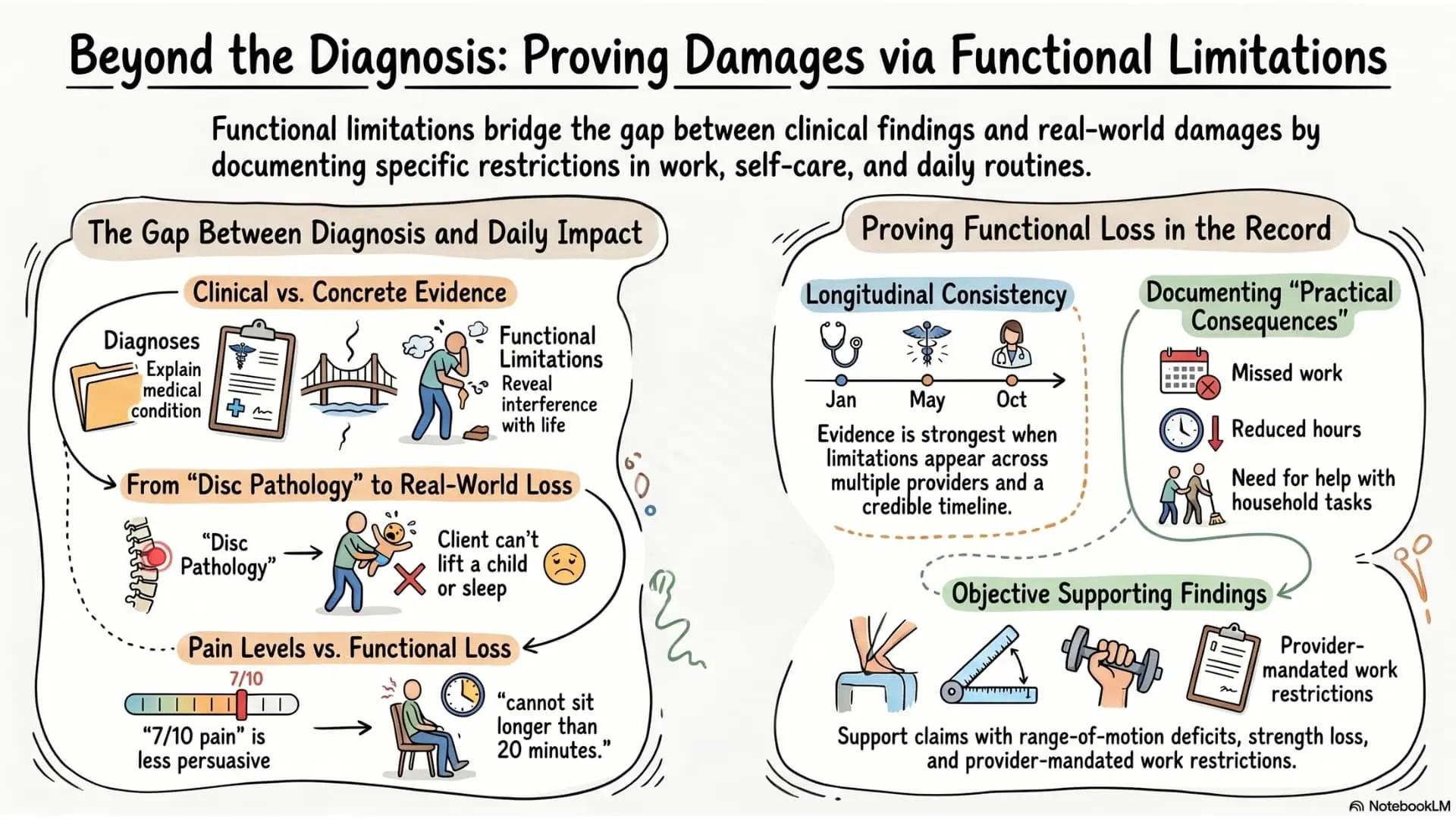
Medical findings become far more persuasive when they are tied to measurable disruptions in a client’s daily life. A herniated disc matters clinically, but the claim becomes more concrete when the record explains that the client cannot sit through a work shift, lift a child, sleep more than four hours, or tolerate the commute that used to be routine.
In more contested claims, this is where medical-legal support can become especially important. Social Surge’s medical record review service is built around organizing records, identifying gaps, and clarifying treatment timelines for Texas PI firms, which is directly relevant when limitations are present but poorly tracked.
The gap between diagnosis and daily impact
Diagnoses explain the medical condition itself, while functional limitations reveal how that condition interferes with everyday life. Those are not the same thing. Two clients can have similar imaging and very different functional outcomes depending on job duties, age, prior health, pain response, treatment access, and family responsibilities.
That distinction is important because injury-related functional limitations often carry the human part of the damages narrative. They show how the injury interferes with ordinary function, not just how it appears on a scan.
What Are Injury Related Functional Limitations?
Simply documenting pain levels is rarely enough to establish meaningful functional loss in a PI claim. Pain matters, but unsupported pain complaints are easy for insurers and defense counsel to minimize. For functional limitations in personal injury claims, the stronger record connects symptoms to specific activities, frequency, duration, and change over time.
A useful limitation record should capture:
- Activities affected, such as walking, lifting, sitting, standing, driving, sleeping, household work, childcare, and job tasks.
- Severity and consistency, including whether the limitation is constant, activity-based, improving, worsening, or fluctuating.
- Medical support, such as therapy notes, physician restrictions, diagnostic findings, specialist referrals, and medication changes.
- Timeline context, including when the limitation began, how it changed during treatment, and whether gaps in care affected the record.
- Practical consequences, including missed work, reduced hours, help needed at home, cancelled activities, or inability to perform normal routines.
At that point, corroborating the client’s complaints with medical documentation becomes significantly more persuasive than relying on subjective reporting alone. The goal is accuracy, not exaggeration. It is to make sure legitimate limitations are visible in the same file that carriers and opposing counsel will review.
Common places where limitations get lost
In many PI cases, evidence of functional loss appears only in fragmented provider notes and scattered treatment updates. One provider may document difficulty climbing stairs, while another focuses on sitting tolerance or sleep disruption. Individually, these notes may seem minor, but together they help establish the client’s functional decline. A case manager may know the client stopped working overtime, but that fact may never make it into the organized medical chronology.
Without a structured review, these details may never appear together in the demand narrative. That can weaken the file even when the underlying evidence is there.
Treatment gaps and incomplete updates
Treatment gaps are not always evidence that a client recovered. Sometimes they reflect transportation problems, delayed referrals, insurance issues, lien-provider coordination delays, or family obligations. Still, if the reason is not documented, the gap may be used against the claim.
Social Surge’s treatment oversight service focuses on monitoring care progress, provider updates, and documentation flow. That kind of oversight helps firms catch missing updates before the demand package has to explain them under pressure.
Provider notes that describe pain but not function
Providers frequently record pain severity while leaving out the practical effects the pain has on daily activity. A note that says “7/10 low back pain” is less useful than one that says the client cannot sit longer than 20 minutes, wakes repeatedly at night, and avoids lifting more than a few pounds.
Documenting functional limitations in PI cases should push the record toward practical specificity. The clearer the functional description, the harder it is for the limitation to be dismissed as a generic complaint.
How medical records help prove functional loss
The strongest damages narratives are supported by consistent documentation across providers, specialties, and treatment phases. A single isolated complaint may help, but repeated observations across therapy, orthopedic care, pain management, imaging review, and work-status documentation carry more weight. For functional limitations in personal injury claims, consistency is the difference between a passing complaint and a damages narrative.
Medical records can support limitations through:
- Objective findings, including imaging, range-of-motion deficits, strength loss, gait changes, neurological signs, and positive orthopedic tests.
- Treatment behavior, such as referrals, therapy progression, injections, surgical consults, medication adjustments, and durable medical equipment.
- Provider restrictions, including limits on lifting, bending, standing, sitting, driving, or returning to work.
- Functional reporting, including documented trouble with work duties, sleep, self-care, household tasks, recreation, or childcare.
- Longitudinal consistency, meaning the limitation appears in a credible timeline rather than only at the end of the claim.
In disputed cases, expert support can help connect the medical opinions to the documented functional loss. Social Surge’s expert witness coordination can help align medical opinions with the records when causation, future care, impairment, or damages are likely to be challenged.

A practical example from a PI file
Consider a client with a lumbar spine injury after a crash. The MRI shows disc pathology, the client completes therapy, and the bills are organized. From a billing and treatment standpoint, the file may look active. But the limitation evidence is thin unless the records explain how the injury changed the client’s life.
A stronger file would show that the client initially could not drive more than 15 minutes, later returned to short drives with medication, still could not lift work materials, and needed help with grocery shopping for several months. If those facts appear across provider notes, therapy updates, and work-status forms, injury-related functional limitations become much harder to dismiss as unsupported.
The same pattern applies to chronic pain, orthopedic injury, spine injury, and catastrophic injury cases. For example, Social Surge’s page on chronic pain cases emphasizes the importance of consistent documentation across multiple visits and providers, which is often where functional evidence is either strengthened or lost.
Building a cleaner limitation narrative before demand
Waiting until demand preparation to organize functional evidence can create avoidable weaknesses in the file. Early review gives the firm time to request missing records, clarify restrictions, obtain updated provider notes, and correct timeline confusion.
This is not about coaching exaggeration; it is about making sure the record reflects the client’s actual functional loss. The objective is a complete and accurate record. If a client cannot work full duty, the file should say why. If the client missed appointments because of transportation barriers, the record should clearly explain those gaps. If the client improved in one area but remains limited in another, the record should reflect both facts.
Questions firms should ask while reviewing the file
During review, attorneys and case managers can look for practical proof points: What activities did the client lose? Which provider documented those limitations? Are the limitations consistent with the diagnosis and treatment path? Did the client’s function improve, plateau, or worsen? Are there unexplained gaps that need context?
Asking these questions during file review helps keep the damages narrative grounded in documented evidence rather than assumption. They also make proving limitations with medical records more efficient because the team knows exactly what the record must support.
Conclusion
A PI claim is stronger when the medical record does more than show that an injury occurred. It should show how the injury changed the client’s function, what treatment was needed, how recovery progressed, and what limitations remained. That is especially true when injury-related functional limitations are documented across the file instead of left in scattered notes.
In serious PI litigation, functional loss often becomes the point where medical evidence, damages, and credibility converge. When they are documented carefully, the case narrative becomes more practical and defensible. When they are missing or scattered, even a legitimate injury can look incomplete.
For Texas PI firms handling complex injury cases, organized review and treatment visibility can make a meaningful difference. A careful medical-legal support process helps turn fragmented records into a clearer damages story before negotiation or litigation forces the issue.