

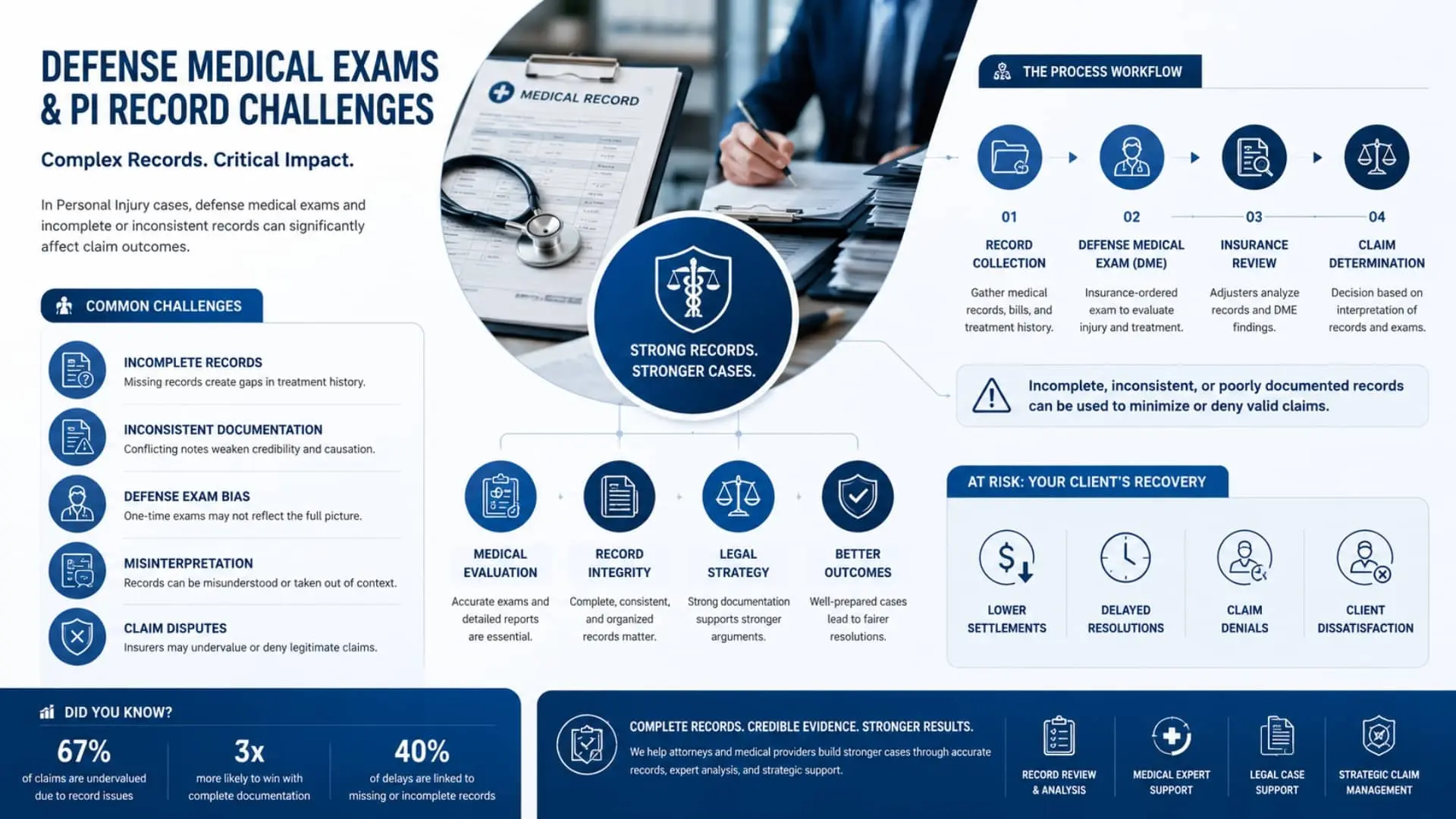
Defense medical exams in personal injury cases can influence claim value long before trial. In many PI cases, the problem is not simply the exam itself; it is how incomplete, inconsistent, or poorly organized medical records give the defense room to reshape the injury narrative.
Treatment gaps, vague provider notes, delayed referrals, unexplained changes in care, and weak medical necessity documentation can all create leverage for carriers and defense counsel. When the medical file does not clearly support causation, treatment progression, and ongoing limitations, the DME or IME report may frame those weaknesses against the claim.
This article explains how defense medical exams and IMEs affect personal injury claims, what record weaknesses examiners often look for, and how PI attorneys can prepare medical records before the defense review process begins.
How Defense Exams Affect Claim Leverage
A defense medical exam gives the carrier or defense team a medical opinion they can use to question injury severity, causation, permanency, or future care.
The report may not directly challenge every part of the claim. Instead, it may suggest that the client improved, treatment lasted longer than necessary, or prior conditions better explain the symptoms. That alone can reduce settlement leverage.
That is why the DME process should be treated as a medical record event. If the file is weak going in, the report can turn documentation problems into defense themes tied to treatment continuity concerns.
Why DMEs Become Record-Driven
During a defense-requested medical evaluation, the examiner usually reviews more than the client’s physical presentation. The report is often built around the treatment timeline, prior history, provider notes, and file inconsistencies.
The examiner may look for whether symptoms began close to the incident, complaints stayed consistent, treatment escalation made clinical sense, and the records explain why care continued after conservative treatment stopped helping rather than simply repeating the same complaints across visits.
Why the Entire Medical File Matters
In many PI claims, the medical file shapes the examiner’s opinion before the physical evaluation even begins.
Early medical record review can help Texas PI firms identify chronology gaps, inconsistent documentation, and causation concerns before the DME report is written.
Why the Defense Requests DMEs
Defense exams are often requested to narrow damages, challenge the medical story, or create a competing explanation.
Common reasons include:
- Disputing whether the incident caused the claimed injury.
- Arguing that treatment was excessive, unrelated, or poorly supported.
- Pointing to prior injuries, degenerative findings, or baseline complaints.
- Questioning symptoms that appear stronger than imaging findings.
- Challenging future care, work restrictions, impairment, or permanency.
- Creating a report that reduces settlement leverage before mediation.
A disputed surgery recommendation, unexplained treatment gap, prior complaint, or vague discharge note can affect valuation if the record does not give the attorney a clear response.
Most defense reports do not rely on a single documentation issue. Instead, they build credibility by combining several small inconsistencies across the treatment timeline.

Common Record Weaknesses Before a DME or IME
Most IME challenges in PI cases begin with routine documentation problems. A firm may have records from emergency care, therapy, imaging, orthopedics, and pain management, but the file may still fail to tell one connected medical story.
In many files, the evidence is technically there. The problem is that the treatment timeline is difficult to follow. Records may be buried, duplicated, mislabeled, or arrive out of sequence across providers.
Treatment Gaps That Never Get Explained
A treatment gap may come from referral delays, scheduling problems, transportation issues, provider availability, financial limits, or confusion about the next step.
If the record says nothing, the defense may argue the client recovered, stopped needing care, or restarted treatment for unrelated reasons. A stronger file explains why the interruption occurred before the defense turns that silence into an argument. In many cases, delays result from referral issues, transportation problems, scheduling conflicts, or limited specialist availability.
Provider Changes That Make the Injury Story Look Uneven
Provider changes are common in Texas PI cases, especially when a client moves from acute care to conservative treatment, imaging, specialist care, injections, or surgical evaluation.
Problems often begin when one provider documents improving mobility while another records worsening radicular symptoms without clearly explaining the change in treatment direction. That is where many IME challenges in PI cases begin to gain traction.
How to Prepare Medical Records Before a DME
A DME file should not be treated like a record dump with the expectation that the examiner will sort through it fairly. Before a DME, the file should be reviewed the way the defense is likely to read it: looking for delay, inconsistency, prior conditions, missing records, weak medical necessity support, and unsupported treatment escalation.
By the time a DME is noticed, the case manager may already be dealing with incomplete imaging records, delayed specialist notes, and out-of-sequence therapy updates. That is why the DME process often becomes a file readiness issue.
When preparing medical records for DME, attorneys and case managers should review:
- Initial complaints, ER records, urgent care notes, and intake forms.
- Imaging reports, procedure notes, therapy records, and specialist evaluations.
- Prior medical history, earlier injuries, degenerative findings, and baseline symptoms.
- Missed appointments, interruptions in care, provider changes, and referral delays.
- Functional limitations, work restrictions, pain patterns, and consistency.
- Missing records, incomplete notes, billing records, and LOP-related documentation.
The purpose is not to sanitize the file. It is to identify where the defense may try to create doubt.
Keep the Record Packet Focused and Usable
A useful record packet should make the sequence easy to follow without forcing the reviewer to reconstruct the timeline from scattered notes, delayed records, or inconsistent provider updates.
Tracking referrals, provider updates, missed visits, and documentation issues earlier can keep the file from reaching the DME stage with unresolved gaps.
Organization alone is not enough if the records never explain why treatment escalated over time.
Causation and Medical Necessity Need Clear Support
A large medical file does not automatically make causation stronger. A large file can still create confusion if the records do not explain why the care occurred and how it relates to the incident.
Medical necessity is not just about whether treatment occurred. The records should explain why each stage of care made clinical sense.
In PI record preparation, the key questions are straightforward:
- Why was the MRI ordered?
- Why did therapy continue?
- Why did specialist care become necessary?
- Why did treatment escalate?
If the notes do not answer those questions, the defense may frame care as excessive, unrelated, or unsupported.
When Imaging and Symptoms Need Context
Imaging can support a claim, but it rarely tells the whole story by itself. A report may mention mild or degenerative findings while the client continues to experience radicular pain, limited motion, or reduced function.
That issue is common in spine injury claims. The record should connect imaging, symptoms, exam findings, and functional limits so the examiner cannot isolate one phrase.
When Chronic Pain Notes Leave Too Much Room for Dispute
Chronic pain cases often become vulnerable when the records document pain but do not explain function. A note that simply repeats “pain unchanged” is far less useful than one that connects pain to sitting tolerance, lifting limitations, sleep disruption, failed conservative care, or procedural response.
What matters is whether the file gives a later reviewer enough detail to understand why symptoms remained medically relevant.
How to Review a DME Report
After a defense exam report arrives, the legal team should compare it against the underlying treatment records.
With IME challenges in PI cases, the goal is not to argue with every unfavorable sentence. It is to separate supported opinions from opinions built on omissions, selective summaries, or missing context.
After receiving the report, legal teams should review:
- Compare the examiner’s summary against the full medical chronology.
- Identify omitted records, misstated complaints, or incomplete treatment history.
- Flag unsupported causation or medical-necessity conclusions.
- Review whether prior history was fairly compared to post-incident symptoms.
- Note ignored functional limitations, treatment response, or provider findings.
- Prepare focused issues for rebuttal, deposition, mediation, or expert review.
A strong response should show where the report skipped a key record, misstated the timeline, overstated a prior condition, or reached a conclusion without addressing contrary documentation.
Final Thoughts: Stronger Records Reduce DME Leverage
Defense medical exams in personal injury cases become most damaging when incomplete records allow the defense to turn a complex treatment history into a simplified defense narrative. Treatment interruptions, inconsistent provider documentation, unclear medical necessity, and unresolved treatment timeline issues can all create leverage during the DME process and IME-related disputes.
A stronger file does more than organize records. It gives attorneys a clearer way to explain the claim before the defense defines the narrative. It also helps connect treatment progression, provider documentation, and ongoing limitations in a way the records consistently support.
For Texas PI firms, stronger medical record organization can improve claim clarity long before a defense review shapes the narrative. Social Surge Marketing helps attorneys identify documentation weaknesses, strengthen treatment chronology, and improve DME readiness before avoidable record issues affect case value.