

A treating physician can carry real weight in a personal injury case. They document symptoms, treatment progress, and clinical findings after an accident. In straightforward claims, that may be enough to support the medical narrative.
But complex PI cases often require more than treatment testimony. When causation is disputed, prior conditions exist, future care is involved, or records come from multiple providers, attorneys need a deeper analysis. That is where Medical record review becomes critical, helping identify gaps, inconsistencies, and issues the treating physician may not fully address.
For high-value PI cases, the key question is not whether the treating doctor matters. The question is whether that physician alone can carry the full medical burden of the case.
Why the treating doctor still matters
Before talking about escalation points, it helps to be clear about what the treater contributes. In most files, that physician creates the first medical timeline. They document complaints, examine the patient, order testing, try treatment, and record how the condition evolves. In straightforward matters, that may be enough to support settlement because the medical story remains linear.
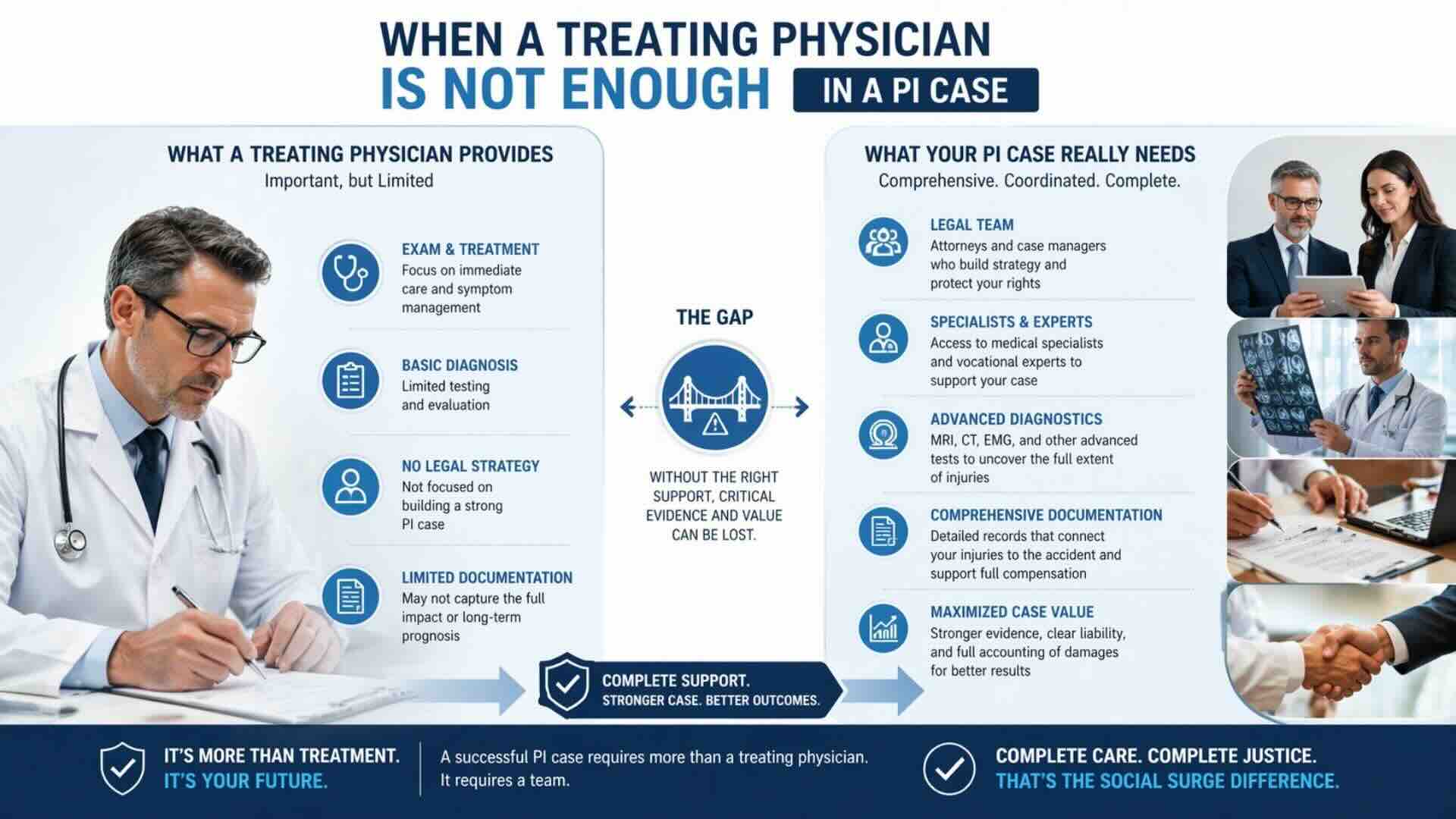
The challenge is that a treating physician is primarily focused on patient care, not on developing a litigation-ready medical analysis. A treating doctor may have strong views, but those views are often formed in the context of diagnosis and treatment rather than a full review of prior records, competing theories, or future-care projections. That difference matters once the defense presses on causation, permanency, or necessity.
When the case starts asking for more than treatment testimony
A case usually outgrows treatment-only evidence when the medical questions become broader than “What did you do, and why?” Once the file turns into a dispute over mechanism, prognosis, or competing explanations, counsel needs to think seriously about when to use a medical expert in PI cases.
The treating doctor can explain care, but not always the whole dispute
A treating physician can usually testify about observations, complaints, diagnoses, and treatment decisions. That is valuable evidence. Still, complex files often require someone who can review a wider record set, address alternative causes, and explain why the injury picture still fits the accident.
That is where expert medical opinion in PI litigation becomes especially useful, particularly in cases involving multiple providers, surgery recommendations, chronic pain, neurological symptoms, or disputed future care. The more the case depends on interpretation rather than simple chronology, the less comfortable it is to rely on treatment testimony alone.
Defense strategy often exposes the gap
Insurance carriers and defense counsel often focus on gaps in treatment, inconsistent notes, prior complaints, missed visits, delayed imaging, or specialist opinions that do not fully align with the initial presentation. A treating physician in personal injury cases may not be prepared to assemble all of that into one clean answer.
In practice, the gap often appears when the defense asks questions the treating doctor did not need to answer during care. Why is this condition trauma-related rather than degenerative? Why is surgery connected to this accident instead of a preexisting condition? Why do current limitations remain credible months later? Those questions are not impossible for a treating doctor to answer, but they are not always questions that doctor is best positioned to handle alone.
Signs the case needs an independent medical voice
Attorneys do not need an outside specialist in every file. They need one when the dispute has outgrown routine chart testimony.
Common signs include:
- The injury mechanism is being challenged
- The client has substantial prior history or degenerative findings
- Future treatment costs are a major damages driver
- Multiple specialties are involved and the records do not tell one clean story
- The treating doctor is reluctant, unavailable, or not suited for deposition and trial work
These are usually the moments when lawyers revisit when to use a medical expert in PI cases instead of waiting until discovery pressure makes the decision for them. In that setting, the question is no longer whether the treating physician in personal injury cases is useful. The question is whether that physician alone can carry the medical burden the case now presents.

Where treating testimony tends to fall short
Treating doctors are valuable, but their role has built-in limits that become visible in heavier litigation.
Limited scope of record review
A treating doctor often works with what is available during care. That may be enough for medicine, but litigation can require a wider frame. Prior records, pharmacy history, earlier injuries, outside imaging, employer files, and specialty consults may all matter. A retained expert can review those materials together and explain how they fit. That kind of synthesis is often what turns a strong set of records into expert medical opinion in PI litigation that can withstand cross-examination.
Time and testimony constraints
Some treating physicians do not want deep litigation involvement. Others are credible clinicians but poor explainers under deposition pressure. Some simply lack the time to review added records or prepare for adversarial questioning. A treating physician in personal injury cases may remain an essential fact witness even while another doctor becomes the stronger opinion witness.
Questions of neutrality
Treaters can also be painted as advocates for their own care decisions or for the patient relationship. That criticism is common. An outside specialist with no treatment relationship may be able to speak with greater distance on causation, necessity, future care, or functional impact. In the right file, that added independence materially improves credibility.
How to decide whether a medical expert is worth the cost
Not every case justifies the added expense, so the decision has to be made strategically. A useful way to think about it is to measure what the file must prove against what the current medical evidence can realistically deliver.
Ask:
- Is there a real causation fight, or only routine posturing?
- Does the value of the case depend on permanency, future care, or work limitations?
- Are preexisting conditions likely to dominate the defense narrative?
- Can the treating doctor explain the issues clearly and confidently beyond the treatment chart?
- Will a neutral specialist materially improve leverage before mediation, deposition, or trial?
That framework helps counsel identify the right point for escalation without adding unnecessary complexity to a routine file. It also forces a direct assessment of whether the treating physician in personal injury cases is being asked to do more than the role naturally supports.
The strongest PI cases connect records, treatment history and expert analysis
The best presentations do not choose between treatment evidence and outside opinion. They connect them. In a well-built file:
- the treating doctor establishes the clinical timeline
- the records show consistency, progression, and functional change
- the expert explains causation, medical necessity, future impact, and disputed issues the defense wants to blur
Case organization matters here too. If the file has fragmented records, undocumented treatment gaps, or poor provider coordination, even a strong expert will spend time repairing the foundation instead of strengthening the argument. That is why firms often pair expert development with better record organization and treatment monitoring.
The broader lesson is the same: before a medical narrative can persuade, it has to be organized, consistent, and clearly supported by the record.
Learn more about how treatment oversight and coordination can strengthen a PI case.
A simple example from a higher-stakes file
Consider a client with prior lumbar complaints who is rear-ended, treats conservatively, later undergoes injections, and eventually receives a surgical recommendation. The treating orthopedist may testify that the patient reported worse pain after the crash and that treatment escalated over time. That helps.
But if the defense argues degeneration, prior symptoms, and unrelated progression, the file may need more than a chronology witness. It may need someone who can review the pre-accident records, compare imaging over time, explain aggravation versus baseline disease, and give a reasoned opinion on whether the accident changed the patient’s course. That is where expert medical opinion in PI litigation often becomes especially valuable. In a file like that, relying only on the treating physician in personal injury cases can leave too much unstated.
Conclusion
A good treating doctor remains one of the most important medical witnesses in a PI file. But good treatment testimony does not automatically answer every litigation question. Once the case turns on disputed causation, future care, preexisting conditions, or a complicated timeline, the smarter move is to recognize that the file now needs a different kind of medical voice.
The strongest firms do not wait for that realization. They identify the pressure points early, tighten the records, preserve treatment continuity, and bring in expert support when the issues demand it. In practical terms, that is when to use a medical expert in PI cases: when the file requires analysis that goes beyond routine treatment testimony. At that point, the case is no longer asking one doctor to serve two separate functions. Instead, it is building a medical presentation that is easier to defend and more persuasive from negotiation through trial. If a firm is dealing with those pressure points, a structured review of the file and better coordination of the medical evidence can make the next step easier for both counsel and the treating physician.